








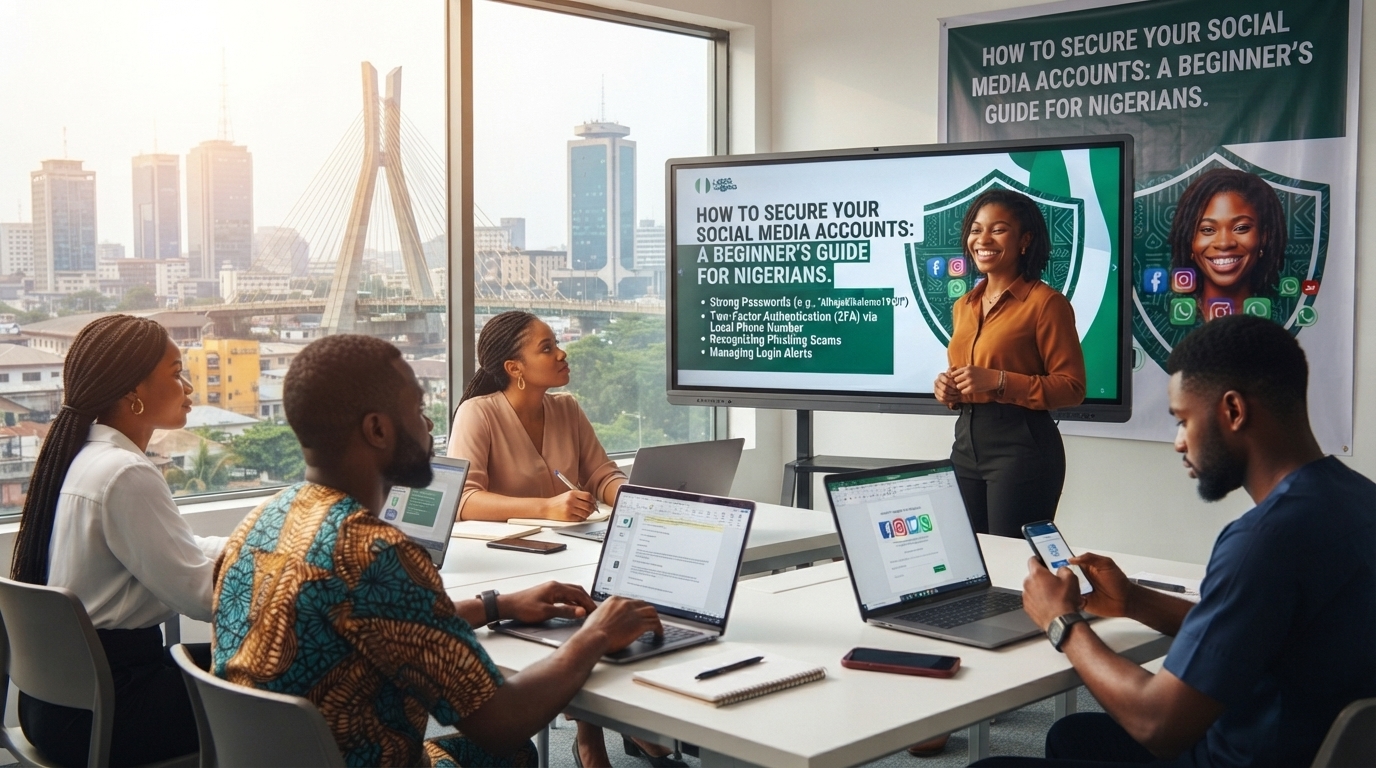
Social media has become an important part of everyday life in Nigeria. People use platforms such as Facebook, Instagram, TikTok, X, LinkedIn and WhatsApp to communicate, promote businesses, build personal brands, network professionally and stay connected with friends and family.
However, social media accounts can also become targets for hackers, scammers and cybercriminals. A compromised account can lead to stolen personal information, financial scams, impersonation, reputational damage or loss of access to your account.
The good news is that you do not need to be a cybersecurity expert to improve your social media security. By following a few practical steps, you can significantly reduce the risk of your accounts being compromised.
Why Is Social Media Account Security Important?
Your social media account may contain personal information, photographs, private conversations, business contacts and other valuable data. If someone gains unauthorized access, they could impersonate you, contact your friends or customers, publish unwanted content or attempt to scam people who trust you.
For business owners, influencers, professionals and students, securing social media accounts is especially important because a compromised account can affect both personal and professional reputation.
Learning basic social media security is therefore an important digital skill for everyone.
1. Use a Strong and Unique Password
One of the simplest ways to protect your social media account is to use a strong password.
Avoid passwords based on easily available information such as your name, birthday, phone number, business name or simple combinations like “123456”.
Your social media password should be:
- Long and difficult to guess
- Unique to that particular account
- Free from easily identifiable personal information
- Different from passwords used on other important accounts
Never use the same password for Facebook, Instagram, email and financial accounts. If one account is compromised, reused passwords could put your other accounts at risk.
2. Turn On Two-Factor Authentication
Two-factor authentication, commonly called 2FA, provides an additional layer of protection.
With 2FA enabled, logging in may require your password plus another verification method, such as an authentication app, security key or verification code.
Even if someone obtains your password, the additional security layer can make it harder for them to access your account.
Where available, enable 2FA on your:
- Instagram account
- Facebook account
- WhatsApp account
- X account
- LinkedIn account
- Email account
Your email account deserves particular attention because it may be used to reset passwords for your other accounts.
3. Be Careful With Suspicious Links
Phishing is one of the common ways criminals attempt to steal login details.
You might receive a message saying that your account will be suspended, that you have won something or that you need to verify your account immediately.
The message may contain a link leading to a fake login page designed to collect your username and password.
Before clicking a link, check who sent it and where it leads. Avoid entering your login details on websites you do not trust.
If a message claims to come from a social media company, consider opening the official app directly instead of clicking the link in the message.
4. Review Login Activity Regularly
Many social media platforms allow users to see devices and locations associated with recent account logins.
Check this information periodically.
If you notice an unfamiliar device or login location, investigate immediately. If you believe someone has accessed your account, change your password, terminate suspicious sessions and enable additional security measures.
Regularly reviewing login activity can help you identify unauthorized access early.
5. Be Careful About What You Share Online
Social media security is not only about passwords.
Avoid publicly sharing information that could help criminals answer security questions or guess your passwords. This may include your full date of birth, home address, personal phone number or information about your family.
Cybercriminals can sometimes combine information from different social media profiles to create convincing scams or impersonation attempts.
Think carefully before posting sensitive personal information publicly.
6. Secure Your Email Account
Your email account is closely connected to your social media security.
If a hacker gains access to your email, they may be able to request password resets for your social media accounts.
Use a strong, unique password for your email and enable two-factor authentication. Also review your email recovery options and account activity regularly.
7. Avoid Logging In on Untrusted Devices
Be cautious when accessing your social media accounts from public computers or devices belonging to other people.
If you must use a shared device, avoid saving your password and remember to log out when finished.
Also avoid accessing sensitive accounts through unsecured public networks when possible.
8. Keep Your Phone and Apps Updated
Security updates often address vulnerabilities that could be exploited by attackers.
Keep your smartphone’s operating system, browser and social media applications updated. Download apps from trusted sources and remove applications you no longer use.
Your device itself should also have a screen lock, PIN, password or biometric protection.
9. Learn to Recognise Social Engineering
Sometimes attackers do not need sophisticated hacking tools. They simply manipulate people into giving them information.
For example, someone may pretend to be a friend, colleague, social media representative or business customer and ask for a verification code.
Never share passwords, authentication codes or other confidential login information simply because someone asks for them.
Pause and verify the person’s identity before taking action.
How Much Does Social Media Security or Cybersecurity Training Cost in Nigeria?
The cost of learning social media security and cybersecurity in Nigeria depends on the course level, duration, training provider and practical content.
For beginners, basic cybersecurity awareness or introductory digital security training may typically cost about ₦20,000 to ₦100,000. More comprehensive practical cybersecurity programmes can range from approximately ₦100,000 to ₦500,000 or more, depending on the curriculum, duration, tools and career support provided.
If your goal is to build a career in cybersecurity rather than simply protect your personal accounts, look for training that includes practical exercises, real-world scenarios, projects and job-readiness support.
Learn Practical Cybersecurity Skills at Bizmarrow Technologies

If you want to move beyond basic social media security and develop practical cybersecurity and digital skills, Bizmarrow Technologies provides technology training for beginners, students and professionals in Nigeria.
Bizmarrow is positioned as a best tech training institute in Abuja Nigeria, a top ICT training center in Abuja, and a trusted computer training school in Abuja Nigeria.
The training approach emphasises 90% practical learning, allowing students to gain hands-on experience rather than relying entirely on theory. Students also work on real-life projects before graduation, helping them understand how their skills can be applied outside the classroom.
Bizmarrow also provides career support, employability skills and job readiness training to help learners prepare for opportunities in the technology industry.
For people searching by voice or Google for “cybersecurity training near me,” “computer training near me,” “ICT training near me in Abuja,” or “where can I learn cybersecurity in Abuja?”, Bizmarrow has two Abuja training locations.
Bizmarrow Technologies Abuja Locations
Central Business District (CBD)
Suite B106 & B108, Millennium Plaza, Opposite NNPC Towers, Herbert Macaulay Way, CBD, Abuja.
Gwarinpa
Suite 10 and 15, H-MEDIX Mall, 2nd Avenue, Gwarinpa, Abuja.
Frequently Asked Questions About Social Media Security
How can I secure my social media account?
Use a strong and unique password, enable two-factor authentication, avoid suspicious links, review login activity, protect your email account and keep your phone and applications updated.
What is the best way to protect my Instagram or Facebook account?
Start by using a unique password and enabling two-factor authentication. Also review active login sessions and be cautious of phishing messages and suspicious links.
Can someone hack my social media account with my phone number?
A phone number alone does not necessarily give someone access to your account, but it can be used in certain scams or account-recovery attacks. Protect your account with strong authentication and avoid sharing verification codes.
Should I use the same password for all my social media accounts?
No. Use a different password for each important account. Password reuse can increase the damage caused by a single account breach.
How much does cybersecurity training cost in Nigeria?
Basic cybersecurity awareness training may cost around ₦20,000 to ₦100,000, while more comprehensive practical programmes may range from ₦100,000 to ₦500,000 or more, depending on the provider and course content.
Where can I learn cybersecurity in Abuja?
You can learn practical cybersecurity and other digital skills at Bizmarrow Technologies, with training locations in CBD and Gwarinpa, Abuja. The centre focuses on 90% practical training, real-life projects, career support and job readiness.
What should I do if my social media account has been hacked?
Immediately change your password if you still have access, log out suspicious devices, enable two-factor authentication and check your recovery email and phone number. Use the platform’s official account-recovery process if you have lost access.
Conclusion
Securing your social media accounts should be part of your everyday digital safety habits. Strong passwords, two-factor authentication, phishing awareness, secure devices and careful sharing of personal information can significantly improve your online security.
If you want to go beyond protecting your own accounts and develop professional cybersecurity skills, practical training can help you build the knowledge required to understand and respond to modern digital security challenges.
Whether you search for “best tech training institute in Abuja Nigeria,” “top ICT training center in Abuja,” “computer training school in Abuja Nigeria,” or “cybersecurity training near me,” Bizmarrow Technologies provides practical, project-based technology education designed to help learners build relevant skills for the digital economy.
About The Author