










Getting a tech job in Nigeria is about more than having a certificate. Whether you are applying for a role in data analysis, software development, cybersecurity, UI/UX design, digital marketing, cloud computing, networking, or IT support, employers want to know what you can do, how you think, and how well you can solve real-world problems.
If you are preparing for your first tech job interview or looking to move into a better technology role, proper preparation can significantly improve your chances of success.
This guide explains how to prepare for tech job interviews in Nigeria, what employers look for, common interview questions, the cost of tech interview and career preparation, and how practical training can help you become job-ready.
What Do Nigerian Tech Employers Look for in an Interview?
Technology employers typically assess a combination of technical knowledge, practical ability, communication skills, problem-solving, and attitude.
Your university degree or training certificate may help you get noticed, but your ability to demonstrate practical skills can make a major difference.
For example, a data analyst may be asked to explain how they would clean a dataset, while a UI/UX designer may be asked to explain a design decision. A software developer could be given a coding problem, while a cybersecurity candidate may be asked how they would respond to a security incident.
This is why hands-on learning and real-life projects are so important when preparing for tech employment.
1. Understand the Job Description
Before attending a tech interview, carefully study the job description.
Identify:
- Required technical skills
- Software and tools mentioned
- Years of experience required
- Responsibilities of the role
- Soft skills expected
- Certifications that may be relevant
- Industry or business knowledge required
Make a list of the skills mentioned in the vacancy and compare them with what you currently know.
If the company requires Excel, SQL and Power BI for a data analyst position, for example, you should be prepared to answer questions and demonstrate practical knowledge of those tools.
2. Research the Company
Do not walk into an interview knowing only the job title.
Research the company’s website, products, services, industry, customers and recent activities. Try to understand what problem the company is solving and how the technology team contributes to the business.
You may be asked:
“Why do you want to work with us?”
A strong answer should show that you understand the company rather than simply saying you need a job.
3. Revise Your Technical Skills
Technical interviews can involve questions, practical assessments, coding challenges, portfolio reviews or problem-solving exercises.
The areas you revise should depend on your career path.
For example:
Data Analyst: Excel, SQL, Power BI, data cleaning, dashboards and data interpretation.
Software Developer: Programming languages, databases, APIs, algorithms, debugging and Git.
UI/UX Designer: User research, wireframing, prototyping, usability, design systems and tools such as Figma.
Cybersecurity Professional: Networking, security fundamentals, threat detection, risk management and incident response.
IT Support Professional: Computer hardware, operating systems, networking, troubleshooting and technical support.
Don’t simply memorise definitions. Practice applying what you have learned.
4. Build and Prepare Your Portfolio
One of the best ways to demonstrate your ability is through a portfolio.
Your portfolio can contain projects you completed during training, personal projects, freelance work, internships or projects created to solve realistic business problems.
For example, a data analyst can present a dashboard showing sales performance. A UI/UX designer can show a mobile app prototype, while a web developer can demonstrate a responsive website.
This is one reason project-based learning is valuable. At Bizmarrow Technologies, training focuses on 90% practical learning, giving learners opportunities to work on real-life projects before graduation.
The objective is not simply to finish a course but to develop practical evidence of what you can do.
5. Prepare for Common Tech Interview Questions
Practice answering questions before the interview.
Some common questions include:
- Tell us about yourself.
- Why did you choose a career in technology?
- Why do you want to work for our company?
- What technical tools do you use?
- Tell us about a project you have completed.
- What was the biggest challenge you faced on a project?
- How did you solve it?
- What do you do when you don’t know how to solve a technical problem?
- Where do you see yourself in five years?
- Why should we hire you?
When discussing projects, explain the problem, your approach, tools used, challenges and result.
6. Improve Your Communication Skills
Being technically skilled is important, but you also need to communicate your ideas clearly.
Avoid using complicated technical terminology simply to sound knowledgeable.
If an interviewer asks you to explain a technical concept, imagine that you are explaining it to someone who understands the business but does not have your technical background.
Clear communication demonstrates confidence and professionalism.
7. Prepare for Practical Tests
Some Nigerian technology companies may ask candidates to complete an assessment before or during the interview.
For example, you might be asked to:
- Analyse a dataset
- Write code
- Design an interface
- Troubleshoot a computer
- Create a digital marketing strategy
- Identify a cybersecurity vulnerability
- Build a simple website
- Present a project
The best preparation is regular practice.
8. Prepare Your CV and LinkedIn Profile
Your CV should be tailored to the specific job.
Highlight relevant technical skills, projects, internships, work experience, certifications and achievements.
If you are a beginner without formal work experience, don’t assume you have nothing to put on your CV. Your practical projects can demonstrate your ability.
Your LinkedIn profile should also clearly communicate what you do and the type of technology role you are seeking.
9. Practise Mock Interviews
A mock interview allows you to practise answering questions in a realistic environment.
It can help you identify problems with:
- Communication
- Confidence
- Technical explanations
- Body language
- Project presentation
- Interview structure
Career guidance and job readiness training can therefore be an important part of technology education, particularly for beginners entering the Nigerian job market.
How Much Does Tech Job Interview Preparation Cost in Nigeria?
The cost of preparing for a tech job interview varies depending on the training provider, duration and services included.
As a general guide, tech career and job-readiness training in Nigeria can range from about ₦20,000 to ₦150,000+, while broader technical courses that include practical projects, career guidance and professional training may cost more.
Free resources can also help, but structured training may provide additional benefits such as instructor guidance, practical projects, CV support, mock interviews and career preparation.
Learn Practical Tech Skills at Bizmarrow Technologies
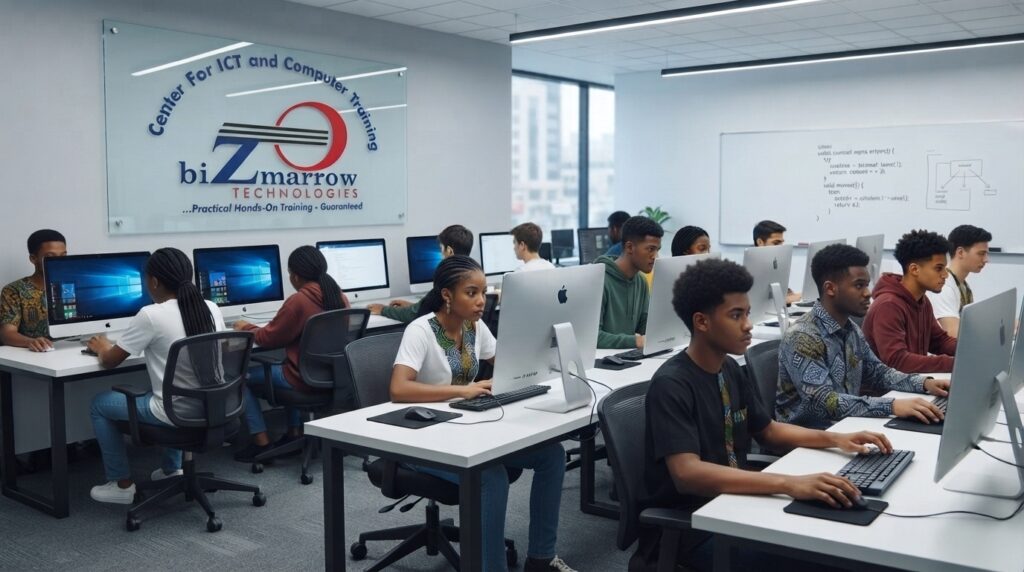
If you are looking for the best tech training institute in Abuja Nigeria, Bizmarrow Technologies provides practical digital skills training designed to help beginners, students and professionals develop relevant technology skills.
Bizmarrow is also positioned as a top ICT training center in Abuja and a computer training school in Abuja Nigeria, offering practical training across areas such as data analysis, UI/UX design, web development, cybersecurity, digital marketing, graphics design, animation, cloud and DevOps, AI and other digital skills.
With 90% practical training, learners work on real-life projects before graduation, while career support and job-readiness training help prepare students for the workplace.
Training is available at:
Central Business District (CBD), Abuja:
Suite B106 & B108, Millennium Plaza, Opposite NNPC Towers, Herbert Macaulay Way, CBD, Abuja.
Gwarinpa, Abuja:
Suite 10 and 15, H-MEDIX Mall, 2nd Avenue, Gwarinpa, Abuja.
If you are searching for “tech training near me,” “computer training school near me,” “ICT training center near me,” or “where can I learn tech skills in Abuja?”, Bizmarrow Technologies offers physical training locations in CBD and Gwarinpa.
Frequently Asked Questions About Tech Job Interviews in Nigeria
How can I prepare for a tech job interview in Nigeria?
Study the job description, revise the required technical skills, research the company, practise common interview questions, prepare your portfolio and participate in mock interviews.
Do I need a university degree to get a tech job in Nigeria?
Not necessarily. Requirements vary by employer and role. Practical skills, relevant experience, projects, certifications and a strong portfolio can be important, particularly for many digital and technology positions.
What should I bring to a tech interview?
Have copies of your CV where appropriate, your portfolio or project links, relevant certificates, identification if required, and any materials needed for a practical assessment.
Are practical projects important for tech jobs?
Yes. Practical projects can demonstrate that you can apply your knowledge to real problems rather than simply explain technical concepts.
How much does tech training cost in Nigeria?
Depending on the course, duration, training provider and level, technology training can range from tens of thousands of naira to several hundred thousand naira. A general career and interview-preparation programme may range from ₦20,000 to ₦150,000+.
Where can I learn practical tech skills in Abuja?
Learners searching for a computer training school in Abuja Nigeria, ICT training or practical technology education can consider training centres such as Bizmarrow Technologies, with locations in CBD and Gwarinpa, Abuja.
What if I have no previous tech work experience?
Start by building practical projects. Create a portfolio, participate in internships or freelance projects where possible, practise interview questions and develop the specific skills required for entry-level roles.
Final Thoughts
Preparing for a tech job interview in Nigeria requires more than memorising interview questions. You need technical knowledge, practical experience, a strong portfolio, communication skills and job-readiness preparation.
The more you practise solving real-world problems, explaining your projects and demonstrating your skills, the more confident you can become during interviews.
For aspiring technology professionals in Abuja, choosing a training provider that combines 90% practical training, real-life projects, career support and job readiness can provide a stronger foundation for entering the technology industry.
About The Author