










One of the biggest concerns for people trying to start a career in technology is the question: “Can I get a tech job without experience?”
The answer is yes. While some technology jobs require years of professional experience, there are several entry-level tech jobs in Nigeria that beginners can pursue after developing the right skills.
You do not always need to start with a university degree in computer science or several years of work experience. For many beginner-friendly roles, employers are interested in your practical skills, portfolio, ability to solve problems, willingness to learn and evidence that you can perform the job.
The key is to learn an in-demand skill, build practical projects and prepare yourself for the workplace.
Can You Really Get a Tech Job Without Experience?
Yes, but “without experience” does not mean “without skills.”
As a beginner, you may not have formal employment experience, but you can demonstrate your ability through personal projects, training projects, internships, volunteer work, freelance assignments and practical exercises.
For example, someone applying for a junior data analyst position could showcase an Excel or Power BI dashboard. A beginner web developer could demonstrate a website they built, while a UI/UX designer could present a mobile app prototype.
Your projects can help employers see what you are capable of doing.
1. Junior Data Analyst
Data analysis is one of the technology-related careers beginners can explore.
A junior data analyst may help organisations collect, clean, analyse and present data to support business decisions.
Useful beginner skills include:
- Microsoft Excel
- Power BI
- SQL
- Data visualisation
- Basic statistics
- Reporting
You can build a portfolio by analysing publicly available datasets and creating dashboards that demonstrate your ability to turn raw information into useful insights.
2. Junior Web Developer
If you enjoy creating websites, web development can provide an entry point into the technology industry.
Beginners can start with:
- HTML
- CSS
- JavaScript
- WordPress
- Basic responsive design
As you progress, you can learn frameworks, databases and other development technologies.
Build several websites before applying for jobs. A portfolio containing functional projects can help demonstrate your abilities even when you have no formal work history.
3. UI/UX Designer
UI/UX design is another career path that can be accessible to beginners who develop strong design and problem-solving skills.
A junior UI/UX designer may assist with:
- User research
- Wireframing
- Prototyping
- Interface design
- Usability testing
- Design systems
Tools such as Figma are commonly used for digital product design.
A strong portfolio is particularly important because employers need to see how you approach design problems and make decisions.
4. Digital Marketing Assistant
You do not necessarily need years of marketing experience to begin working in digital marketing.
Entry-level digital marketing roles may involve:
- Social media management
- Content creation
- Search engine optimisation
- Email marketing
- Online advertising
- Website analytics
You can gain practical experience by creating a sample social media campaign, developing a content strategy for a fictional business or helping a small business improve its online presence.
5. IT Support Technician
IT support is another potential entry point for people interested in technology.
An entry-level IT support professional may help users troubleshoot computer problems, install software, configure devices and resolve basic technical issues.
Useful areas to learn include:
- Computer hardware
- Operating systems
- Networking fundamentals
- Troubleshooting
- User support
- Basic cybersecurity
Strong communication skills are also important because IT support professionals work directly with users.
6. Graphics Designer
Graphics design can provide opportunities for beginners who have developed practical creative skills.
You can start by learning tools such as Photoshop, Illustrator, CorelDRAW or Canva and building a portfolio.
Your portfolio could include:
- Business branding
- Logos
- Social media graphics
- Flyers
- Posters
- Marketing materials
For creative roles, your portfolio can sometimes speak more loudly than your previous employment history.
7. Junior Cybersecurity Roles
Cybersecurity is a rapidly developing field, although many specialist cybersecurity positions require experience.
Beginners can start by developing foundational knowledge in areas such as:
- Network security
- Cybersecurity fundamentals
- Security awareness
- Threats and vulnerabilities
- Access control
- Security monitoring
Practical labs, projects and entry-level certifications can help demonstrate your commitment and knowledge.
8. Virtual Assistant or Digital Operations Assistant
Technology has also created opportunities in digital administration and remote work.
A virtual assistant may handle:
- Email management
- Scheduling
- Online research
- Data entry
- Document preparation
- Customer communication
- Basic social media tasks
Strong computer skills, communication and organisation can help beginners enter this area.
How to Get a Tech Job Without Experience
The most important thing is to replace a lack of employment experience with evidence of practical ability.
Follow these steps:
Learn One Marketable Skill
Avoid trying to learn everything at once. Choose one career path and develop foundational skills.
Build Real Projects
Create projects that demonstrate your ability to solve realistic problems.
Build a Portfolio
Put your strongest work in an accessible online portfolio. Include a description of each project, the tools you used and what you achieved.
Create a Strong CV
Highlight your technical skills, projects, certifications, education and relevant experience.
Optimise Your LinkedIn Profile
Use a professional headline, describe your skills clearly and regularly share your projects and learning progress.
Apply for Internships and Entry-Level Roles
Do not wait until you feel completely ready. Apply for internships, junior positions, apprenticeships and relevant volunteer opportunities while continuing to improve.
Why Practical Training Matters for Beginners
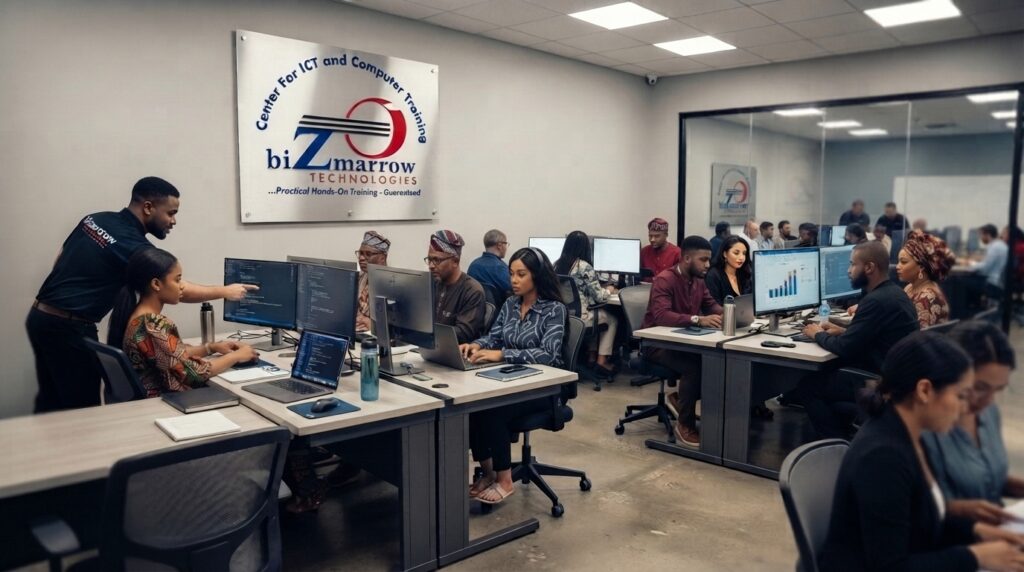
One of the challenges beginners face is learning technology without knowing how to apply it.
At Bizmarrow Technologies, students receive 90% practical training, allowing them to spend significant time applying the concepts they learn.
Students also work on real-life projects before graduation, helping them develop practical experience and portfolio materials that can be presented to potential employers or clients.
Bizmarrow also provides career support and job readiness, helping learners prepare for the professional side of their career—including CV preparation, portfolio development, interview preparation and understanding workplace expectations.
For anyone searching for the best tech training institute in Abuja Nigeria, a top ICT training center in Abuja, or a computer training school in Abuja Nigeria, practical learning and career preparation should be important factors when choosing where to train.
How Much Does It Cost to Learn Tech Skills in Nigeria?
The cost of learning an entry-level technology skill depends on the course, duration, learning format and training provider.
As a general estimate, practical digital skills training in Nigeria can cost between ₦30,000 and ₦300,000+.
Short introductory programmes may fall toward the lower end, while comprehensive professional programmes covering multiple tools, practical projects, trainer support and career preparation may cost more.
If your goal is employment, do not choose a course based on price alone. Consider the practical training, projects, trainer support, curriculum, certificate and career support included.
Where Can I Learn Tech Skills in Abuja?
If you are looking for tech training near me, computer training near me or ICT training near me in Abuja, Bizmarrow Technologies offers practical technology and digital skills training for beginners, students, graduates and professionals.
Training areas include data analysis, UI/UX and product design, web development, digital marketing, graphics design, cybersecurity, cloud and DevOps, artificial intelligence and other digital skills.
Bizmarrow has two Abuja training locations:
Central Business District (CBD), Abuja
Suite B106 & B108, Millennium Plaza, Opposite NNPC Towers, Herbert Macaulay Way, CBD, Abuja.
Gwarinpa, Abuja
Suite 10 and 15, H-MEDIX Mall, 2nd Avenue, Gwarinpa, Abuja.
Final Thoughts
Getting your first technology job without formal experience is possible, but you need to demonstrate that you can do the work.
Choose an in-demand skill, learn the fundamentals, practise consistently, build real projects, create a portfolio and apply for entry-level opportunities.
Your first job may not be your dream role—and that is okay. The goal is to gain experience, develop professionally and use each opportunity as a stepping stone toward more advanced positions.
For beginners in Abuja, practical training can shorten the gap between learning a skill and becoming job-ready.
With 90% practical training, real-life projects before graduation, career support and job readiness, Bizmarrow Technologies helps aspiring tech professionals develop practical skills they can use to pursue internships, entry-level jobs and freelance opportunities.
Frequently Asked Questions About Entry-Level Tech Jobs
Can I get a tech job without experience in Nigeria?
Yes. Many entry-level technology roles are open to beginners, although requirements vary by employer. Build practical skills and projects to demonstrate what you can do.
What is the easiest tech job to get without experience?
There is no single easiest tech job for everyone. Entry-level opportunities can include digital marketing assistant, IT support, graphics design, virtual assistant, junior data analyst, junior web developer and UI/UX design roles, depending on your skills.
Which tech skill should I learn as a beginner?
Choose a skill that matches your interests and career goals. Popular options include data analysis, web development, UI/UX design, digital marketing, cybersecurity, graphics design and artificial intelligence.
Can I get a tech job without a computer science degree?
Yes. Some technology roles place significant emphasis on practical skills, portfolios and demonstrable competence rather than a specific computer science degree. However, individual employers may have their own educational requirements.
How long does it take to become job-ready in tech?
The timeframe varies based on the career path, your starting level, learning consistency and the complexity of the skill. A focused beginner should expect to spend several months developing foundational skills and practical projects.
How much does it cost to learn a tech skill in Nigeria?
A general estimate for practical digital skills training is ₦30,000 to ₦300,000+, depending on the programme, duration, provider and level.
Do I need a portfolio to get an entry-level tech job?
A portfolio is not always mandatory, but it can significantly strengthen your application. It gives employers evidence of your practical abilities, especially when you have limited professional experience.
Where can I learn tech skills near me in Abuja?
If you search for “tech training near me,” “computer training near me” or “ICT training centre near me” in Abuja, consider Bizmarrow Technologies, which has training locations in CBD and Gwarinpa and offers 90% practical training, real-life projects, career support and job-readiness preparation.
Is Bizmarrow Technologies suitable for beginners?
Yes. Bizmarrow provides practical digital skills training for beginners, students, graduates and professionals. Students work on real-life projects before graduation, helping them build practical experience and portfolio-ready work.
About The Author