





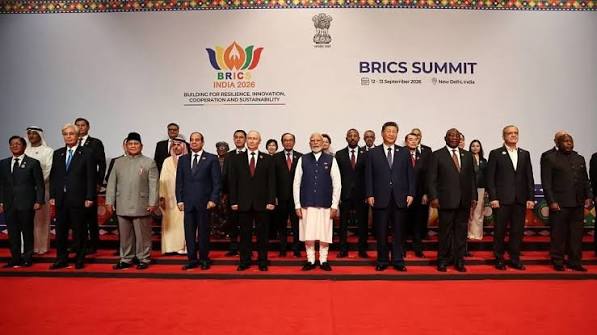
BRICS leaders addressed a session of the 18th BRICS Summit in the Outreach format in New Delhi, where participants presented a range of initiatives under the four priorities of India’s chairmanship: resilience, innovation, cooperation and sustainability.
Partner countries of the group, including Nigeria, as well as representatives of regional and international organisations, also participated in the session.
Summing up India’s BRICS chairmanship, Prime Minister Narendra Modi said BRICS countries had agreed to establish an integrated system for responding to outbreaks of infectious diseases.
Recommendations have also been prepared for sharing early-warning data during emergencies, alongside a framework programme for cooperation in logistics supply chains.
Other initiatives include BRICS Connect, which is focused on skills development, increasing employment, empowering women, strengthening the workforce and expanding social protection.
A BRICS cooperation portal for small and medium-sized enterprises (SMEs) has also been launched to support small businesses. In addition, the BRICS Urban Future Forum has been established to facilitate the exchange of knowledge and experience among member countries on transport-related issues.
In sustainable development, a BRICS Digital Centre of Excellence for Smart Grids and Energy Storage Systems has been established. Centres of Excellence in Agroecology and Regenerative Agriculture will combine traditional knowledge with modern scientific advances.
The BRICS countries also agreed that indigenous knowledge and the experience of local communities should be considered when adapting to the effects of climate change.
Modi stressed that solutions developed within BRICS should not benefit only the group’s member countries but should also be accessible and adapted to the needs of countries in the Global South.
“The strength of BRICS lies in our diversity and cooperation. May our diversity remain our distinctive feature, our cooperation a source of inspiration, and our progress serve all humanity,” he said.
Russian President Vladimir Putin said BRICS is now one of the driving forces behind strengthening multilateralism and shaping a fairer multipolar world order.
According to Putin, intra-BRICS trade has reached US$1.2 trillion, while BRICS countries account for almost a quarter of global exports.
He noted that the group’s potential remains far from fully utilised. The main untapped reserve, he said, is the complementarity of member countries’ economies, as differences in economic structures and specialisations create opportunities for cooperation and the development of new production chains, technologies, services and markets.
Putin also focused on the New Development Bank, which has financed 123 projects worth almost US$40 billion. However, he noted that financing needs remain higher.
He said a new investment platform could help address these needs by using modern financial technologies, including digital assets, to support not only BRICS countries but also economies of partners in the Global South and East.
Chinese President Xi Jinping presented five initiatives aimed at deepening practical cooperation among BRICS countries.
The proposed projects include the creation of the first BRICS open-access zone for artificial intelligence technologies, support for the development and application of large language models, and training programmes.
Xi also called for the establishment of a BRICS Engineering Talent Development Alliance and the launch of a youth science and innovation exchange programme to train highly qualified specialists.
According to the Chinese President, BRICS countries should strengthen production and supply chains, promote innovation and jointly advance the digital economy.
Egyptian President Abdel Fattah El-Sisi said challenges facing the global economy demonstrate the need to build more resilient economies.
He said this could be achieved by diversifying sources of growth, strengthening supply chains, investing in human capital and technology, and expanding cooperation among countries of the Global South.
In this regard, Egypt attaches great importance to cooperation in innovation, artificial intelligence and technology localisation, as well as the role of young people in the economy of the future.
El-Sisi called for expanded cooperation in clean energy and improved access for developing countries to financing and technology. He also highlighted the role of the New Development Bank in supporting infrastructure projects and providing concessional lending.
According to him, Egypt has significantly expanded its efforts to modernise ports and transport corridors.
The Suez Canal occupies a central position in this system as one of the most important routes for international trade, placing responsibility on Egypt for maintaining the stability of supply chains.
Iranian President Masoud Pezeshkian stressed that three key principles — resilience, cooperation and sustainable development — should form the basis of the group’s future work.
According to Pezeshkian, economic resilience is impossible without security.
He also highlighted Iran’s potential to develop trade and energy ties among BRICS countries, noting that the country’s geographical position and capabilities in energy and transport could contribute to creating new routes for cooperation.
The Iranian President further placed particular emphasis on technology and innovation.
Earlier, the heads of state adopted the New Delhi Declaration of the BRICS Summit, which is being held in the Indian capital from Sept. 12 to Sept. 13.
About The Author