The Kogi Government is exploring digital technology, artificial intelligence (AI) and investment opportunities to transform the state’s tourism sector and maximise its cultural and historical assets.
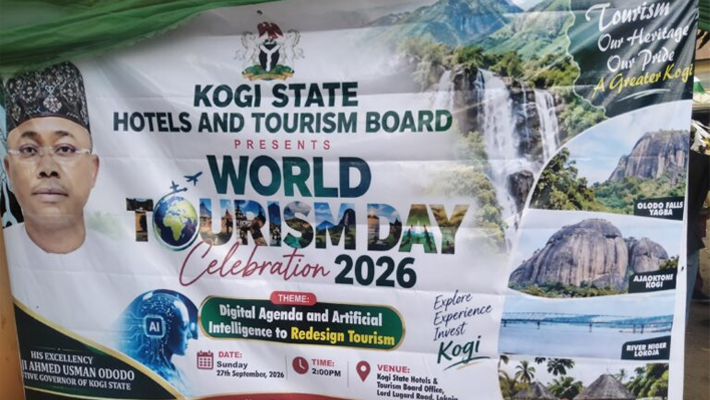
The Kogi Commissioner for Culture and Tourism, Mrs Fatima Momoh, disclosed this on Sunday in Lokoja during an event to commemorate the 2026 World Tourism Day.
World Tourism Day is observed annually on Sept. 27 to highlight the contribution of tourism to economic development, cultural exchange, employment and sustainable development.
The 2026 celebration focuses on the role of digital innovation and artificial intelligence in reshaping tourism and improving access to tourism products and services.
Represented by the Director of Tourism Development, Alhaji Tanko Inuwa, Momoh said technology had significantly changed tourism promotion and service delivery.
She said the state was working to bring tourism and hospitality facilities into the digital space, allowing visitors to search for destinations and book hotels remotely.
According to her, plans are also underway to develop Mount Patti into a major tourist hub, including a proposal for the installation of a cable car.
She noted that Mount Patti holds historical, religious, social and economic significance, including its connection with the origin of the name “Nigeria.”
Momoh said the state government remained committed to tourism development through improved infrastructure, effective policies and digital innovation.
She added that a Culture and Tourism Committee had been constituted to position Kogi as a tourism hub and establish a unified cultural heritage festival.
The commissioner said the state was also working towards developing a comprehensive tourism masterplan and policy to attract investors and strengthen capacity within the sector.
She further identified improved security as essential to tourism development, saying efforts were being made to further strengthen peace across the state.
Also speaking, Mr Idowu Ibikunle, Chairman of the Kogi House of Assembly Committee on Culture and Tourism, described tourism as an important contributor to economic development.
He said the year’s focus on digital technology and artificial intelligence reflected the growing role of technology in tourism development.
Ibikunle said tourism was not only about travelling but also about creating jobs, promoting culture, fostering peace and showcasing communities to the world.
“Tourism is not just about travel. Tourism is about jobs. It is about culture. It is about peace,” he said.
He noted that Kogi had enormous tourism potential and called for increased investment in the sector.
Ibikunle assured that the assembly would provide legislative backing for policies capable of attracting private-sector investment into tourism.
He added that the assembly would support the protection of culture, heritage and ecosystems while empowering youths and women through tourism entrepreneurship.
The lawmaker urged stakeholders to “rethink tourism” and invest in Kogi and Nigeria’s rich cultural and tourism assets beyond oil.
Mr Philip Orebiyi, General Manager of the Kogi Hotels and Tourism Board, said the state had started using digital platforms and artificial intelligence to promote its tourism destinations.
“You can be wherever you are to search events, destinations, hotels, book ahead and then transport yourself. All these are also done by digital technology,” he said.
Orebiyi said the board was restoring colonial relics and other landmarks, including European cemeteries, with support from the Commonwealth of Cemeteries International.
He said cultural festivals were also being digitalised, while the board was profiling hotels across the state to assess their capacity, safety and compliance with required standards.
According to him, the board was targeting youths with digital and creative skills to enable them to participate actively in the tourism and creative industries.
“We’re on all the platforms. We’re on YouTube. We’re on Facebook. We’re working on our website,” he said.
Orebiyi said Kogi’s position as a transit state provided an opportunity to develop activities that would encourage travellers to spend nights in Lokoja.
“The focal point is to create activities that will entice people to want to stay the night in Lokoja,” he said.
He said accommodation facilities should cater to different categories of visitors, stressing that they did not necessarily have to be five-star establishments but should be comfortable and affordable.
Orebiyi identified administrative bottlenecks and bureaucracy as some of the challenges facing the sector but said the board was exploring collaborations and local content to advance tourism.
A tourism stakeholder, Baba Ojonugwa, said Kogi had the Confluence, colonial masterpieces, cemeteries and other attractions capable of drawing visitors from across the country and beyond.
“I don’t think there is any part of the country that has the tourist attraction that Kogi has,” he said.
The News Agency of Nigeria (NAN) reports that the event featured cultural performances and participation by cultural troupes, legal practitioners, ministry officials and representatives of the Council for Arts, among other stakeholders.
About The Author