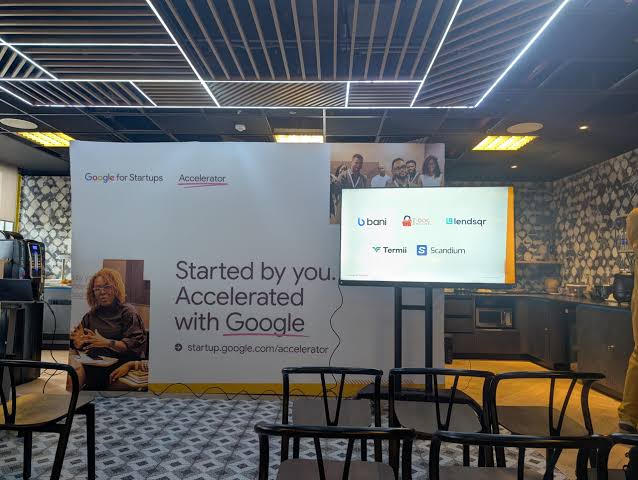
Aiyegbusi made the remarks on Thursday at the FounderConversations event organised by Google, where he said Nigerian tech startups and their counterparts across Africa that have participated in various Google accelerator programmes have attracted about $1.3 billion to the continent.
“There are certain numbers that you see as press. You see us talk about the number of jobs created, the funding raised, how many cohorts we’ve run, and a number of other statistics,” he said.
“Those are very abstract. If you’re a part of the press and you hear that every time it’s time for a program, it becomes very abstract and you don’t understand the implications of these numbers. So what I want to do today is help explain what these startups are doing before they come on stage, and explain what these numbers actually mean.
“Funding raised. When you think about it, funding raised, jobs created, and then sort of like what are they doing?
“Let’s start with the funding raised number. Today, these startups, if we actually include the African or Nigerian startups that participate in our programmes, we have startups that have raised over $1.3 billion. Brought in $1.3 billion onto the continent. Again, the numbers sound very abstract.”
STARTUPS CREATING JOBS, IMPROVING LIVELIHOODS
Aiyegbusi said Nigerian founders are not only creating solutions and raising funds but are also contributing to the economy through job creation, skills development and improved living conditions in communities around them and beyond.
“This is one other, one major, one other avenue that FDI is coming onto the continent and then onto the country,” he said.
“It’s a very big deal. Our dollar is stabilising because of many different verticals, but it’s also because of the startups. That’s one. It’s jobs created. These startups are creating jobs. And it’s more than just a team of – they’re creating jobs and solving problems with this funding.
“It’s more than just the founders that you will see today. There are machines behind these founders of five, 10, 20, 50 people that are building aggressively and scaling these solutions themselves that the founders are building.
“Now, what it also looks like, what that funding looks like, is paying people well enough to go out and further impact their different communities. Think of it as a pyramid; when you think about the numbers. It’s a pyramid.”
TERMII
Speaking on the importance of tech startups in the lives of Nigerians, Olajuwon Abayomi, general manager (GM) for Termii operations in Nigeria, said his company is addressing some of the challenges associated with digital transactions.
Abayomi said Termii is behind some of the one-time passwords (OTPs) and transaction notifications customers receive.
“If you have sent somebody money today, and you needed maybe to get a one-time password, or to get a notification to let you know that the funds have gone through, that notification you get, or that one-time password you requested, that will be delivered in less than 10 seconds, Termii was responsible. So, that’s really what we’ve been doing the last nine years,” he said.
NIGERIANS TO RECEIVE NOTIFICATIONS TO RETRY FAILED AIRTIME TRANSACTIONS
The general manager said the company has also developed a solution that will notify bank app users when a failed airtime transaction can be completed after the financial institution resolves a service disruption.
“You know, today, if you’re using a bank app, let’s say, for example, you try purchasing airtime, and for whatever reason, their airtime service goes down. When you make that attempt and it’s not successful, and you move on to another bank, if you notice, the bank never communicates to you to say, ‘oh, okay, we noticed you attempted making an airtime purchase, you know, but we’re not able to do it successfully. Now the issue is resolved, can you make another attempt?’ No bank in Nigeria does that,” he said.
“The reason is because there is no solution that empowers them to listen to every customer engagement on their product and be able to intuitively engage with their customers to ensure that they retain revenue. So we have also solved that problem by developing a platform we call ‘Termii Engage’. So what Termii Engage does is that it helps businesses using AI to segment their different categories of customers, listen to customers’ journeys using their products, and intuitively engage them.”
E-DOC ONLINE
Tunde Ogundipe, co-founder and chief executive officer (CEO) of E-Doc Online, said his company provides data that helps businesses meet market and regulatory requirements.
Ogundipe said regulations around anti-money laundering, stablecoins and ultimate beneficial ownership (UBO) have increased the need for the solutions developed by the company across different sectors.
“So we’re now seeing a lot of regulation around whether it’s anti-money laundering, CFT. There’s now a growing demand for financial data to do those regulations. Even in terms of UPUs now, ultimate beneficiary owner,” he said.
“So we’re seeing a growing demand for not just for the data analytics we do, we’re seeing a growing demand for the regulatory data as well. And there is also the infrastructure that we built, in terms of direct connection to banks, a lot of companies or a lot of partners are now leveraging on this.”
BANI
Also speaking during the event, Rodney Jackson-Cole, founder of Bani, said the company was created to connect African countries on a single platform for cross-border transactions.
“The idea came from how do we standardise commerce across the continent. If I’m a merchant in Nigeria for example, how do I easily accept payments for my customer in Ghana? Or if I want to sell something to someone in Tanzania or Senegal for example, how does that collection process look like?” Jackson-Cole said.
Highlighting the challenge his company is addressing, he said transactions are carried out differently across Africa.
“In Nigeria, we have bank accounts and our banking system works 100 percent.”
“In other markets like Senegal, mobile money is what is paid there. So payments is very fragmented.”
SCANDIUM
Alabi Zubair, vice president of product and business development at Scandium, said his company uses artificial intelligence (AI) to conduct quality assurance on applications and ensure they are ready for use.
“It helps basically to ensure that whatever products they’re building web or mobile applications, you can validate and ensure that they actually work and function well, so. And you can also. do away with the stress of having to sit down manually the test every time you ship,” Zubair said.
“So today, you have AI assistants that can help you code. People are shipping new features every hour, every day that gets extremely harder to follow through, so it’s always stressful if you have to do it manually and you have to do the traditional way, you have to write code and all of that.
“It’s unsustainable, right? So Scandium builds tools that takes all of that trouble away from you. So, Ruba AI is our flagship product. You just give it a product, maybe a URL, or upload the app. And that’s it. It’s going to go in there, understand (and) find ways to achieve the goal that you have set for it.”
Speaking about the role of the media in the technology sector, Zubair encouraged the media to highlight success stories within the industry.
About The Author