










Africa’s Tech Growth Story Shifts as Consolidation Takes Centre Stage in H1 2026
Investors, founders, and industry leaders have offered a candid assessment of the changing dynamics within Africa’s technology ecosystem, examining why early-stage funding has declined, the role African venture capital must play in supporting startups, and where the next phase of growth is emerging.
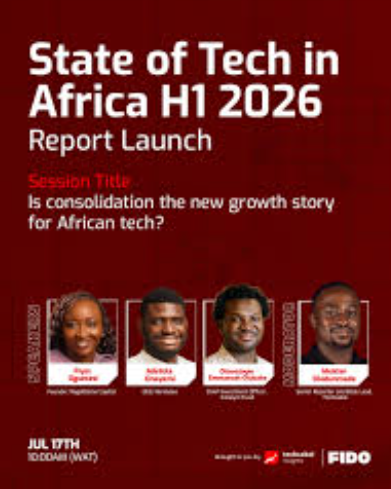
The discussions took place during the launch of TechCabal Insights’ State of Tech in Africa (SOTIA) H1 2026 report, held on Friday, July 17, 2026, in Lagos. The report launch was organised by TechCabal Insights, a digital economy consultancy, with support from sponsor and partner Fido, a fintech company providing instant, unsecured digital loans and financial services.
The report, presented by Joseph Oloyede, an analyst at TechCabal Insights and lead author of the publication, highlighted major shifts in Africa’s technology funding landscape.
According to the report, Africa’s technology ecosystem has raised $21 billion since 2019. In H1 2026, funding increased slightly by 1.4% year-on-year, reaching $1.44 billion, compared with $1.42 billion in H1 2025. However, the number of deals dropped significantly from 252 to 174.
Debt financing accounted for 41% of total funding, while early-stage startups attracted only $9 million, a decline from $25 million in H1 2025. Meanwhile, mergers and acquisitions increased by 91% year-on-year, while layoffs rose by 236%, with restructuring and AI adoption identified as major factors behind workforce reductions.
The report also revealed that African investors contributed only 37% of capital raised, while international investors accounted for 63%.
Taken together, the figures suggest that funding is no longer expanding Africa’s technology ecosystem primarily by creating more startups. Instead, capital is increasingly being directed toward fewer, larger, and more established companies.
Is Consolidation the New Growth Story for African Tech?
According to Tomiwa Aladekomo, CEO of BigCabal Media, the organisation behind TechCabal, this type of analysis is the reason SOTIA was created.
He explained that the report began from a 2019 question about Nigeria’s health tech sector that lacked sufficient data-driven answers. Over the past seven years, that same approach has expanded across Africa, providing regular insights into what is happening in the ecosystem, who is driving change, and what it means for founders, investors, and policymakers.
“The question now is, is consolidation the new growth story for African technology?” asked host Gertrude Umeh, setting the stage for the panel discussion that followed.
Why Early-Stage Funding Has Declined
During the panel, moderated by Muktar Oladunmade, a senior reporter at TechCabal, industry leaders discussed the reasons behind the decline in early-stage capital.
Fiyin Ogunlesi, founder of RegalStone Capital, an African investment and advisory firm, said the current funding environment requires founders to demonstrate stronger market readiness before raising capital.
She explained that with investors becoming more disciplined, entrepreneurs must do more work upfront to prove their products can expand across different markets and regulatory environments.
“There’s no capital to explore to say we will take a chance,” she said, adding that founders now need to “already oversell” their readiness for expansion.
Oluwatosin Emmanuel-Olubake, chief investment officer at Catalyst Fund, an early-stage venture capital fund, highlighted broader global factors affecting startup funding.
He pointed to interest rate changes by the US Federal Reserve, which have encouraged investors to move capital toward safer assets, as well as reduced US and European development funding as governments redirect spending toward defence priorities.
He also noted that many limited partners (LPs) have become more hesitant to support first-time fund managers, who traditionally provide some of the earliest startup funding.
As a result, even pre-seed founders now face higher expectations. However, Emmanuel-Olubake noted that startup progression from pre-seed to seed funding has slowed rather than collapsed, and many venture funds have adapted by creating multi-round investment structures that allow them to support companies they strongly believe in.
Is the Problem Caution or Lack of Conviction?
The discussion became more intense when Adetola Onayemi, CEO of trade technology startup Norebase, presented a different perspective.
He argued that the funding slowdown is not only a result of market conditions but also reflects what he described as a lack of confidence among investors.
“I think that what we’re seeing happen in the space is a function of cowardice,” he said.
Onayemi argued that African founders have increasingly adjusted their ambitions based on available capital instead of building companies with larger visions.
“If you cannot do venture capital, don’t do venture capital. Be a private equity fund,” he said. “If you say you’re a venture capital fund, it is literally venture capital. Put your money at risk.”
He also criticised technology journalism that focuses heavily on how much funding startups raise rather than the lessons learned from companies that fail.
According to him, greater willingness to discuss failure could encourage more experimentation and innovation. He referenced Konga as an example of a company that did not achieve commercial success but still influenced the growth of e-commerce across Africa.
Emmanuel-Olubake challenged comparisons between African venture markets and Silicon Valley, noting the significant difference in available capital and market maturity.
He argued that African venture capital is still developing and should be evaluated according to its own stage of growth rather than compared directly with more mature ecosystems.
Expanding the Definition of Startup Success
When asked about the future measures of success within Africa’s technology ecosystem, Onayemi argued that the market should move beyond an obsession with unicorn valuations.
He called for more companies valued between $100 million and $500 million—businesses large enough to create significant impact and attractive enough to be acquired by banks or larger companies.
“What we have now is a crash of companies all trying to be unicorns, a few companies in between, and a lot of debts,” he said.
He also identified a shortage of strong B2B enterprise sales talent, noting that Africa has produced relatively few large B2B technology companies and therefore lacks a deep pipeline of enterprise sales professionals.
Looking ahead, Onayemi highlighted four trends likely to shape the ecosystem:
- More founders entering frontier AI and targeting global markets
- Increased focus on B2B technology solutions
- Greater use of alternative financing options, including debt and private capital
- More data-driven investment decisions
He also noted that startups are becoming more proactive about protecting intellectual property and trademarks as they expand across markets, citing the Zap-Paystack dispute as an example influencing this shift.
Creative Economy and Local Capital Opportunities
Ogunlesi also highlighted the creative economy as an emerging technology opportunity.
She described the sector as underdeveloped but increasingly recognised as a mainstream technology space requiring specialised investment structures.
She called for better systems around royalty aggregation, intellectual property financing, and rights management, explaining that industries such as film, music, fashion, and gaming require different approaches rather than a single equity model.
“It’s a space where you have to create the structures to invest per vertical,” she said, predicting more specialised funds focused on individual creative sectors.
She also noted growing interest from domestic pension capital in exploring fund-of-funds structures as a pathway into venture investment.
Onayemi added that the technology sector needs stronger engagement with regulators and policymakers. He described the Startup Bill as an important foundation but said more work is required.
He encouraged startups to build in regulated sectors such as healthcare and energy rather than focusing mainly on asset-light business models.
Fido’s Approach to Closing Africa’s Credit Gap
Following the panel discussion, Philip Twum, Head of Business Development at Fido, shared the company’s efforts to address Africa’s credit access challenges through alternative data.
Fido has served more than 2 million borrowers, disbursed $1 billion, and raised $74 million to date. The company operates across Ghana, Uganda, Zambia, and South Africa.
Twum explained how Fido uses its AI-powered credit scoring system, the Fido Score, to assess borrowers without relying solely on traditional documentation or collateral.
The company has also partnered with Access Bank on a savings product and with Bolt and Uber to provide credit solutions for gig-economy drivers.
His closing message was that building a reliable underwriting system for underserved borrowers can unlock large-scale financial inclusion opportunities across Africa.
The SOTIA H1 2026 report ultimately highlights a technology ecosystem entering a new phase—one where growth may depend less on rapid startup creation and more on stronger companies, smarter capital allocation, sustainable business models, and deeper market infrastructure.anies, smarter capital allocation, sustainable business models, and deeper market infrastructure.
About The Author