









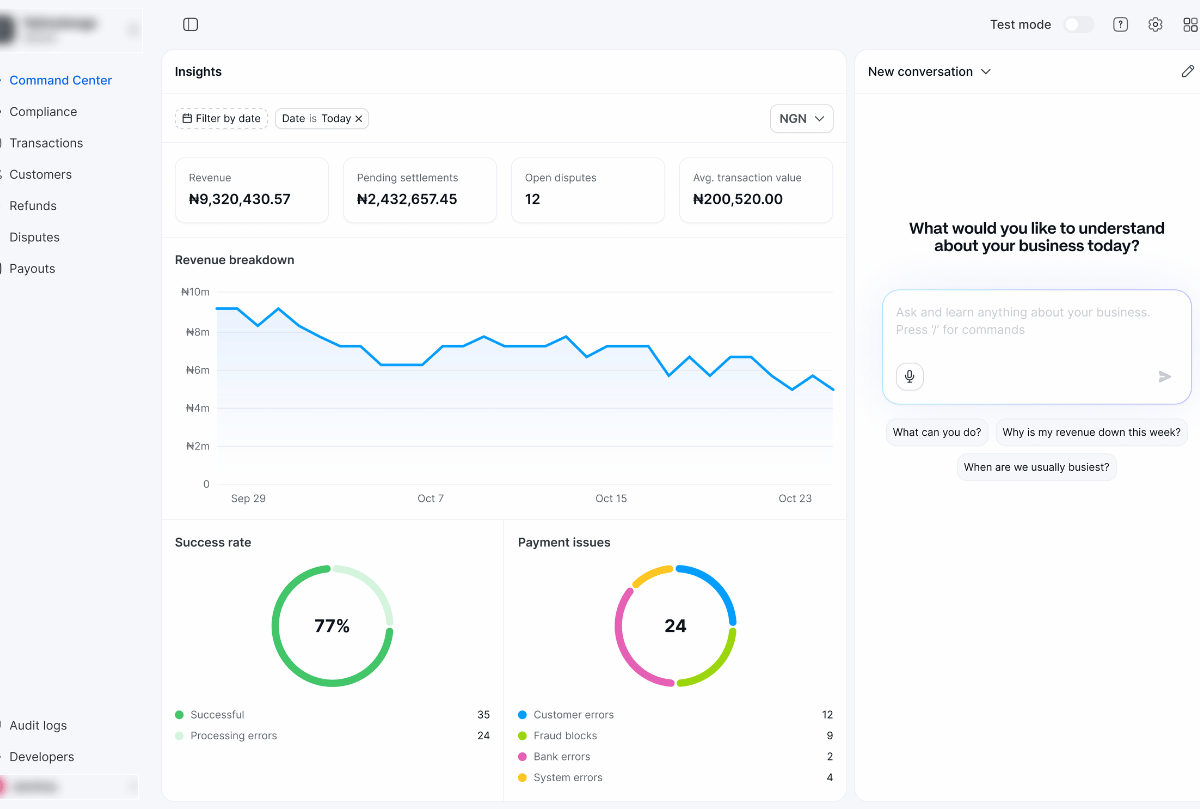
African fintech giant Paystack has unveiled Canvas, a fully rebuilt next-generation merchant dashboard designed to transform how businesses manage payments, monitor performance, and interact with financial data.
The launch marks the first major rebuild of Paystack’s dashboard in 10 years and introduces an AI-native experience aimed at helping businesses make faster, smarter, and more informed decisions. According to the company, Canvas was rebuilt from the ground up to reflect how modern businesses operate in an increasingly digital and AI-driven economy.
For thousands of merchants across Africa, the Paystack Dashboard has long served as the operational center for handling transactions, settlements, disputes, customers, and business analytics. But as digital commerce evolved, Paystack recognized the need for a more intelligent, simplified, and scalable platform.
The introduction of Canvas signals Paystack’s broader move toward integrating artificial intelligence into financial operations while improving the user experience for merchants of all sizes.
Why Paystack Rebuilt Its Dashboard
According to Paystack, the original dashboard grew organically over the last decade as the company added new products, workflows, and merchant tools. While this expansion increased functionality, it also created complexity that made navigation and data management more difficult for users.
The company explained that what initially started as a visual redesign quickly evolved into a complete rethinking of the entire merchant experience.
Paystack’s product and engineering teams began asking a more fundamental question:
If Paystack were building its dashboard from scratch today, what would it look like?
That question eventually led to Canvas , a rebuilt platform featuring:
- Simplified navigation
- AI-powered business intelligence
- Faster workflows
- Mobile and desktop parity
- Modern architecture
- Improved accessibility
- Modular product organization
The project reportedly began in late 2025 and took approximately five months to complete from design to launch. (Paystack)
Introducing Canvas: Paystack’s New Merchant Experience
Canvas is not simply a cosmetic update. It represents a complete redesign of how merchants interact with their financial and operational data.
The new dashboard introduces:
- An AI-native Command Centre
- Conversational business insights
- Simplified payment management
- Smarter navigation systems
- Enhanced reporting tools
- Integrated data visualization
- Responsive mobile functionality
Paystack says the goal is to move away from static dashboards that force merchants to manually search for information and instead create an intelligent interface capable of answering business questions directly.
The company described Canvas as a platform built for “modern businesses” operating in a world increasingly shaped by automation and artificial intelligence.
The AI-Native Command Centre
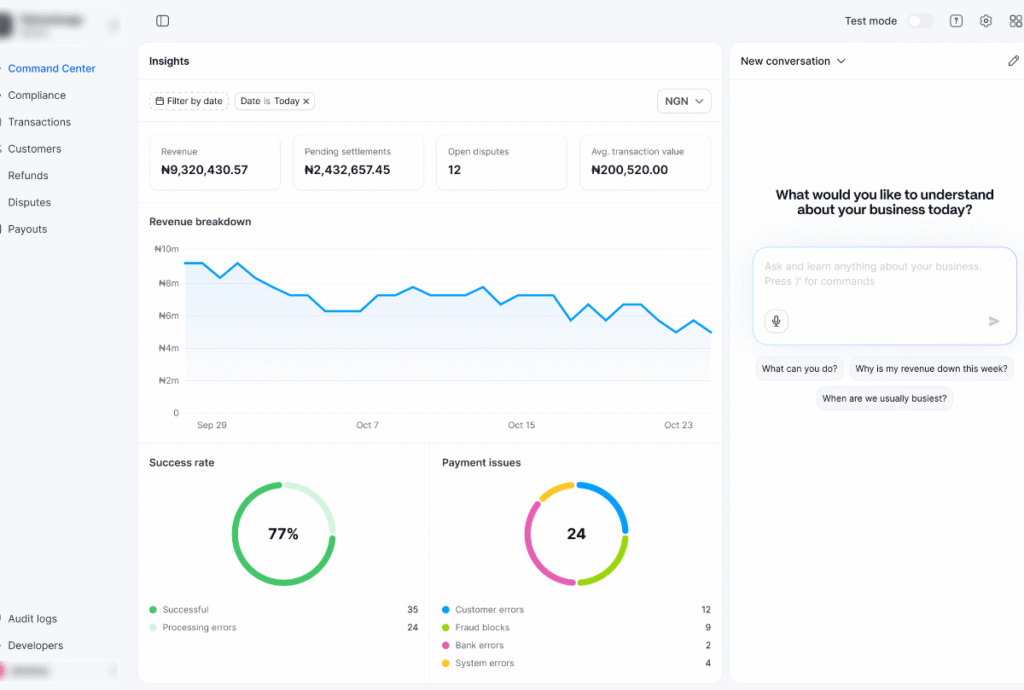
One of the most significant features of Canvas is its AI-powered Command Centre.
Rather than navigating through multiple menus and filters, merchants can now ask questions in plain language and receive responses directly from their business data.
Examples include:
- “Why is revenue down this week?”
- “What happened with this transaction?”
- “Do I have any unresolved disputes?”
- “Show me transactions from this customer”
- “Which payment channels are performing best?”
The system then responds using:
- Text summaries
- Tables
- Charts
- Transaction analysis
- Contextual explanations
According to Paystack, the AI system combines GPT-based models, structured data retrieval systems, and visualization tools to generate responses grounded in actual merchant data.
This conversational approach is designed to save businesses time while making financial insights easier to access and understand.
AI-Native, Not AI-Added
One of Paystack’s key design philosophies behind Canvas is what it describes as “AI-native, not AI-added.”
Instead of simply attaching a chatbot to the dashboard, Paystack redesigned the interface itself around AI interactions. (Paystack)
This means:
- The dashboard adapts based on context
- AI tools are embedded directly into workflows
- Merchants interact naturally with business data
- Navigation becomes less dependent on menus and filters
For example, if a merchant is viewing a transaction page, the AI understands the context and can provide transaction-specific assistance without requiring additional searches.
Paystack says this approach reflects the future of software interfaces, where users increasingly interact with systems through conversations rather than manual navigation.
Simplified Navigation and Better Organization
Another major improvement in Canvas is its redesigned navigation system.
Paystack conducted extensive merchant research and usability testing to understand how businesses actually search for information. The company found that users often struggled because information was not organized in ways that matched real-world business workflows.
As a result, Canvas simplifies the dashboard into two major categories:
- Payments
- Products
Payments
This section focuses on core transaction-related workflows such as:
- Transactions
- Customers
- Refunds
- Disputes
- Settlements
Products
This section houses Paystack’s modular business tools and newer product offerings, including:
- Transfers
- Splits
- Commerce tools
- Additional financial services
The redesign aims to reduce friction and make it easier for merchants to find important information quickly.
Mobile and Desktop Parity
Another important improvement is full mobile functionality.
According to Paystack, Canvas was designed to provide the same experience across mobile devices and desktop systems.
This means merchants can:
- Monitor transactions
- Access analytics
- Review settlements
- Ask AI questions
- Manage operations
- Handle disputes
directly from their smartphones without losing key functionality.
This is especially important in African markets where many entrepreneurs and business owners rely heavily on mobile devices for daily business operations.
The Role of AI in Financial Management
Canvas reflects a larger trend across the fintech industry where AI is increasingly being integrated into financial tools and business operations.
Businesses today face growing complexity involving:
- Revenue tracking
- Customer management
- Fraud prevention
- Payment reconciliation
- Financial forecasting
- Operational analysis
Traditional dashboards often require manual searching and interpretation, which can consume valuable time.
AI-powered financial interfaces aim to simplify these processes by:
- Automatically surfacing insights
- Explaining trends
- Detecting anomalies
- Generating reports
- Improving decision-making
According to Paystack’s product team, the ultimate goal is to make dashboards feel less like static reporting tools and more like intelligent operational assistants
Security, Privacy, and Trust
Because Canvas handles sensitive financial data, security and compliance were major priorities during development.
Paystack stated that the system was built with:
- Data protection safeguards
- Privacy controls
- Response validation systems
- Adversarial testing
- Data Protection Impact Assessments (DPIA)
The company says responses generated by the AI are grounded in verified merchant data to reduce hallucinations and misinformation.
This is especially important as AI becomes more integrated into financial systems where accuracy and trust are critical.
What This Means for African Businesses
The launch of Canvas highlights how African fintech companies are increasingly competing at a global product level.
For years, fintech innovation in Africa focused heavily on payment accessibility and digital banking infrastructure. Now, companies like Paystack are moving into:
- AI-powered financial tools
- Intelligent analytics
- Automated business management
- Workflow optimization
- Merchant intelligence systems
This evolution reflects the growing maturity of Africa’s digital economy.
Many African businesses still face operational challenges such as:
- Limited financial visibility
- Manual accounting systems
- Poor reporting structures
- Limited business intelligence tools
Platforms like Canvas could help small and medium-sized enterprises make more data-driven decisions without requiring advanced technical expertise.
Paystack’s Growth Over the Years
Since launching in 2016, Paystack has grown into one of Africa’s most influential fintech companies.
The company provides payment infrastructure that enables businesses to:
- Accept online payments
- Process transactions
- Manage customers
- Automate billing
- Handle settlements
- Run commerce operations
Paystack was acquired by Stripe in 2020 in a deal reportedly worth over $200 million, one of the largest startup acquisitions in Africa at the time.
Since then, the company has expanded across multiple African markets while continuing to build tools for merchants, developers, startups, and enterprises.
Canvas represents another major step in Paystack’s product evolution beyond payment processing.
Challenges and Industry Competition
While Canvas introduces impressive innovation, Paystack still operates in a highly competitive fintech environment.
The African fintech space now includes strong competition from companies such as:
- Flutterwave
- Moniepoint
- Kora
- Fincra
Online discussions among merchants also reveal ongoing concerns around:
- Customer support
- Payment reliability
- Regulatory compliance
- International card processing
- Transaction delays
As fintech competition intensifies, product experience and operational intelligence may become increasingly important differentiators.
The Future of AI in Fintech
Paystack’s AI-native dashboard also reflects a broader transformation happening across the global fintech industry.
AI is increasingly being used for:
- Fraud detection
- Customer support
- Financial forecasting
- Automated accounting
- Business analytics
- Risk management
- Personalized financial recommendations
Experts believe AI-powered financial systems could significantly improve productivity for businesses by reducing manual work and improving operational visibility.
The African AI market is also expected to grow rapidly over the next decade as businesses adopt automation and intelligent digital systems.
Canvas may therefore represent an early example of how AI could reshape merchant operations across Africa.
Conclusion
Paystack’s launch of Canvas marks one of the company’s most significant product upgrades in a decade.
By combining AI-powered business intelligence, simplified navigation, mobile accessibility, and modern design architecture, the company is attempting to redefine how African businesses interact with financial data and payment operations.
Rather than functioning as a traditional reporting dashboard, Canvas positions itself as an intelligent business management interface capable of answering questions, surfacing insights, and helping merchants make faster decisions.
As AI continues reshaping the future of software and financial technology, platforms like Canvas suggest that conversational business management may soon become the new standard for digital commerce tools.
For African businesses navigating increasingly complex digital economies, smarter financial management systems could become essential for growth, efficiency, and competitiveness.
Frequently Asked Questions (FAQ)
-
What is Paystack Canvas?
Canvas is Paystack’s newly rebuilt merchant dashboard designed to provide AI-powered business insights, simplified navigation, and smarter financial management tools.
-
Why did Paystack rebuild its dashboard?
Paystack rebuilt the dashboard to improve usability, simplify workflows, integrate AI features, and better support modern business operations.
-
What is the AI-native Command Centre?
It is an AI-powered feature that allows merchants to ask questions about their business in plain language and receive data-driven answers instantly.
-
What types of questions can merchants ask?
Merchants can ask about revenue trends, transactions, disputes, customer activity, settlements, and other operational data.
-
Does Canvas work on mobile devices?
Yes. Paystack says the new dashboard offers full functionality on both mobile and desktop devices.
-
How does Paystack ensure AI accuracy?
The company says responses are grounded in verified merchant data and supported by validation systems, privacy safeguards, and security testing.
-
Is Canvas available to all Paystack merchants?
Paystack has introduced Canvas as its new dashboard platform for merchants using Paystack services.
-
Why is this launch important for African fintech?
Canvas demonstrates how African fintech companies are increasingly integrating artificial intelligence into business management and financial operations.
About The Author