Before the 2023 General Election, Nigeria’s election result management system was largely a physical process in which polling unit results were recorded on paper and transmitted through successive collation centres.
After voting, the presiding officer counted the ballots and recorded the results on Form EC8A. Party agents and election officials endorsed the form before the results were announced and the materials transported to the designated collation centre.
Collation officers then aggregated the results at the ward, local government area (LGA) and state levels, after which the returning officer declared the winner. Proper counting, transportation, collation and announcement of election results, when carried out without compromise, can be regarded as a hallmark of transparency.
However, distortions and manipulations often occurred at different stages of the collation process.
IReV introduced
For a long time, many Nigerians viewed the electoral process as a “black box.” There was a widespread belief that votes did not always count, with the lack of trust contributing to voter apathy, particularly among young people.
The introduction of INEC’s Result Viewing Portal (IReV) in August 2020 marked a significant step towards greater transparency, allowing citizens to access polling-unit result sheets, known as Form EC8A, online for the first time.
The platform was designed to enable polling-unit result sheets to be electronically uploaded, allowing members of the public to view the results online as the collation process continued.
Rather than waiting for INEC to complete the collation process and announce the final outcome, data companies and other election stakeholders, including Dataphyte and Mundx Analytics, use civic technology to track and present election results with infographics as they are announced at polling stations. This gives voters an opportunity to cross-check the results and flag discrepancies where necessary.
The technology makes it possible to compile, analyse and publish results in near real time, an opportunity previously restricted to INEC.
These technologies provide an additional safeguard against electoral manipulation, particularly allegations of result alterations.
Mundx, Dataphyte
Martin Uwakwe, founder of Mundx Analytics, a civic technology company that monitored, covered and disseminated about “97.7 per cent” of the Osun governorship election, said the company built a technology layer on top of IReV.
“As polling-unit result sheets become available, our system identifies the polling unit, uses AI to read and structure the information on the form, runs several validation checks, flags abnormalities, and aggregates the results,” Mr Uwakwe said.
The process appears straightforward: INEC publishes individual result sheets, while the technology processes thousands of those sheets at scale and in near real time.
However, the information interpreted by the technology still depends entirely on what INEC uploads, although it provides an opportunity to cross-check individual polling-unit results.
“Importantly, our results remain tied to the underlying polling-unit records, so people can inspect the source rather than simply taking our numbers on trust.
“We do not source election results from social media, party agents, or unofficial reports. Our primary source is the polling-unit result sheet published on INEC’s IReV portal,” he clarified.
In a separate interview, Joshua Olufemi, founder of Dataphyte, said the organisation used three systems to monitor and report the 2026 Osun governorship election: a network of election observers, an optical character recognition (OCR) tool and its Nigeria Election Data Observatory (NEDO) platform.
Mr Olufemi said the human observers provided real-time information on election incidents, administration and result collation at the polling-unit, ward and local government levels.
“First, we deployed a human network of election observers who worked round the clock to provide real-time updates on incidents, general election administration and the polling unit level, ward level, LGA level result collation across the state,” he said.
“Second, we built an optical character recognition (OCR) technology tool that converts paper-based results from our election observers reporting from the field, and those scraped in real time, directly from INEC’s IREV portal.
“This helped us to quickly transmit the results data into the reporting and data visualisation maps and charts for dissemination across our media channels,” Mr Olufemi said.
The third system, he said, was the Nigeria Election Data Observatory (NEDO), which allows Dataphyte to collect election datasets from multiple platforms, process them and share them with consortium partners through analysis, reports and visualisations.
“Osun helps us to test this third platform in preparation for the general election in January and February 2027,” he said.
Ekiti, Osun election coverage
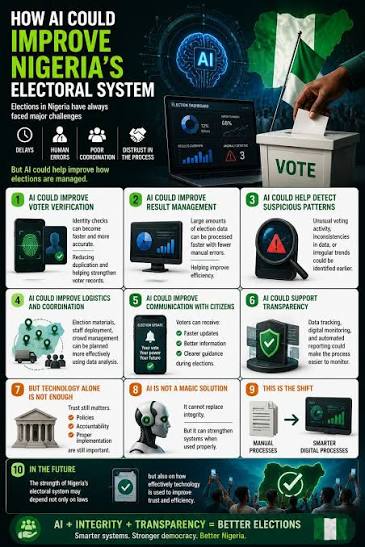
AI-powered data analytics can process very large amounts of information quickly. Unlike the manual process of reading thousands of individual result sheets, the system can process many documents simultaneously as they become available.
The firms deployed the technology during the Ekiti and Osun off-cycle elections in 2026, using the elections as an opportunity to test their systems under real-world conditions ahead of the 2027 General Election.
During the Osun election, Mundx said it covered 3,754 of the state’s 3,763 polling units, representing 97.7 per cent of the uploaded forms counted in its tally. It processed 1,804 forms, flagged 1,864, queued 42 for processing, retried five and excluded 39.
In Ekiti, Mundx covered 2,390 of 2,445 polling units, or 98 per cent of uploaded results. It processed 1,256, flagged 1,016, read 11 and excluded 107.
The “flagged polling units” were those with blurry or mutilated result sheets and other anomalies, including vote-sum mismatches, overvoting and arithmetic errors.
The “queued polling units” were result sheets that had been submitted but were still undergoing manual review.
“In the elections we have monitored, our aggregate tallies have been very close to the final officially declared results, with less than 5 per cent divergence,” the AI system founder stated.
Mundx said it runs mathematical and logical checks on every result sheet to verify that figures, vote totals, accredited voters and registered voters are internally consistent. It also checks whether result sheets have subsequently been replaced or altered on IReV.
“These checks are important because AI is only one part of the system. We do not simply ask an AI model to read a result sheet and immediately publish whatever it says. The extracted information must pass several independent checks before we can be confident in it,” he said.
Mundx’s polling-unit tally for the Osun election was about “95.68 per cent” accurate compared with INEC’s final result, as some IReV results were missing, unreadable, cancelled, corrected or replaced.
The firm said it reported only the results it could obtain and process from IReV rather than adjusting its figures to match INEC’s final declaration.
In the Ekiti State election, Dataphyte’s analysis flagged 452 result sheets with numerical inconsistencies out of a total of 2,390 result sheets from the election. More than 100 of these contained visible alterations to the figures recorded on the forms.
For the Osun State election, Dataphyte’s analysis of 3,752 polling-unit results uploaded to INEC’s IReV portal identified errors in more than 900 polling units.
Speaking on the possibility of errors in AI systems, Mr Olufemi said results obtained by field monitors and transmitted in real time could also help identify possible errors or manipulation in results published on IReV.
He, however, said differences between data from IReV and NEDO’s field network could arise from legitimate changes made during the formal collation process, including cancellations by INEC in accordance with electoral law.
“Results data coming from our field monitors who send us, in real time, result data makes it easy to flag errors or manipulations in results published on IREV.
“The difference that may occur is possible in two scenarios. One, the final results on IREV and that provided by NEDO human network may be different from the results at the final collation stage due to cancellations by INEC due to issues admissible by the electoral law for cancellation,” Mr Olufemi said.
He also acknowledged that errors could occur within Dataphyte’s own system, particularly during analysis.
“The other situation where error may be from Dataphyte’s NEDO is human error during analysis,” he said.
Mr Olufemi said the OCR technology used by Dataphyte had reached what he described as a 98 per cent accuracy level, while human verification was used to check data produced by both field monitors and machines.
He said Dataphyte’s experience during the Osun election had increased its confidence in handling election data during the 2027 General Election.
“The error-free and seamless operations during Osun give us confidence that we would have near-zero error in data handling and publishing come general elections in 2027,” he said.
Reliance on IReV
One of the major issues facing election tracking is the reliance on IReV for tracking and analysing election results. Questions remain about what could happen if there are problems with the IReV portal or the uploading of results, as witnessed during the 2023 presidential election, which INEC attributed to a glitch.
The Dataphyte founder, Mr Olufemi, said IReV was only one of the three data sources used by Dataphyte during the Osun election. This, he said, meant the organisation could rely on its other monitoring and data collection mechanisms if the IReV portal failed.
“As I explained, IREV is one of the three data sources we used during the Osun elections; so if it fails, the other two data collection and election monitoring mechanisms will hold up,” he said.
He said the NEDO consortium planned to deploy human observers to more than half of the first-level election collation centres across Nigeria ahead of the 2027 elections, while discussions with other election-monitoring groups were ongoing to expand the coverage.
“What the NEDO consortium offers us as of today is deployment of a human network of observers in more than half of the first-level election collation centres across the country come January 2027.
“With ongoing partnership conversations with other election monitoring groups’ initiatives, the NEDO consortium hopes to capture the entire first-level result collation centres across the country,” he said.
The consortium currently comprises five civic technology and observer-network organisations: BudgIT Foundation, Centre for Journalism Innovation and Development (CJID), Dataphyte Foundation, DEAN Initiative and YIAGA Africa.
Mr Olufemi said the organisations bring different capacities in election monitoring, results data and reporting.
“So, while we don’t expect INEC to disappoint Nigerians in the discharge of their constitutional duties, we are prepared to complement data that may come from IReV with our authentic boots on the ground,” he said.
Asked what the system would rely on if IReV failed, Mr Uwakwe said Mundx currently did not have the resources to deploy observers across all polling units to independently capture Form EC8A result sheets.
He said IReV had performed well in elections conducted in 2026, adding that Mundx was also putting pressure on INEC to ensure its systems function effectively.
“80 elections happened this year, and IReV worked well for all elections. We are also mounting pressure on INEC to ensure they get their systems right,” he said.
Other challenges
Another major challenge is the accuracy, legibility and quality of the results uploaded by INEC to IReV during elections.
Traditional optical character recognition (OCR) performs extremely well on clean, printed or typed documents. The challenge arises when AI has to process handwritten election forms, poor-quality photographs, overwriting, cancellations or mutilated sheets.
Under such conditions, standard OCR may not provide the level of reliability required to accurately reproduce election results from IReV.
Mr Uwakwe of Mundx said the company adopted an AI vision model, using a dual-model approach rather than traditional OCR, to improve the readability and interpretation of results. The system rejects or flags ambiguous and inconsistent results.
The dual-model consensus approach reduces the risk of a single model misreading a figure.
He said the approach contributed to the high level of accuracy recorded during the recent elections.
“That is why we moved towards AI vision models that are better able to interpret both the text and the context of what appears on a result sheet.
“Even then, we did not want to rely on a single AI model. Each result is independently analysed by two different AI models, and their outputs are compared. If they agree, the result can proceed to our other validation checks. If they disagree, it is not automatically accepted,” he explained.
Another major risk associated with generative AI is hallucination, where a model can confidently produce an incorrect interpretation.
Addressing this concern, Mr Uwakwe said the company approached the system by considering not only what AI could do but also how it could fail and what controls could be built around those risks.
“We therefore run multiple validation checks on every result before accepting it. We also preserve the connection between our extracted data and the original polling-unit result sheet, enabling us to check our interpretation against the source,” he said.
According to him, there will always be some residual risk that a result sheet could be misinterpreted, particularly when the original image is of poor quality.
He said the objective was to make that risk extremely small, detectable and auditable rather than assume that AI could never make a mistake.
Ahead of 2027
The AI system has monitored only two state elections, one at a time. A bigger concern is how it will respond to the General Election, which will involve 36 states and the Federal Capital Territory and more than 170,000 polling units.
“For us, trust is not simply about matching INEC’s final number. It is about allowing people to see the polling-unit evidence behind the numbers and identify where discrepancies or abnormalities may exist.
“So our goal for 2027 is to process as close to 100 per cent of the available and usable polling-unit results on IReV as technically possible, while clearly identifying what is missing, unreadable, cancelled, or unresolved.
“In fact, we would rather transparently mark a polling unit as unresolved than publish a number we are not confident about,” Mr Uwakwe said.
Meanwhile, the major costs of running an election-generation technological system for a country as large as Nigeria include AI processing, cloud computing, data storage, bandwidth, engineering, monitoring and cybersecurity.
The system also requires technological infrastructure capable of keeping the platform available during periods of very high traffic, such as the Nigerian General Election, which involves hundreds of thousands of result documents and potentially millions of users.
The challenge for Nigerian civic technology operators is therefore not simply building the software but ensuring that the system remains fast, reliable and available throughout an election when Nigerians depend on it.
The Mundx founder said the Ekiti and Osun state elections provided the firm with considerable real-world data on what works, what fails and the unusual cases that can arise when processing actual Nigerian election result sheets.
He added that the firm aimed to improve the process of resolving disagreements between models and ensure that questionable results were not simply forced through the system.
“Ekiti and Osun were important real-world tests. The 2027 general election requires us to take what worked at the state level and engineer it for a national scale.
“We are taking those lessons into preparation for 2027. That includes strengthening our validation rules, improving how we identify low-confidence results, and developing better ways to handle difficult or damaged forms,” he said.
On the other hand, the Dataphyte executive, Mr Olufemi, said Dataphyte’s field-monitoring system had been operating since 2023, while its experience during the 2026 elections had been strengthened by improvements in OCR technology and AI.
“Success rate with field monitoring has remained optimal since 2023, when we started monitoring. The 2026 interactions have also improved with OCR technology and the increasing capacity of AI in transforming information into multilingual analysis, multimedia outputs and visualisation,” he said.
He said the NEDO consortium planned to combine the resources and experience of its member organisations ahead of the 2027 elections.
“For 2027, we are combining field agents’ resources, monitoring experiences and information verification and civic messaging of at least five organisations with coverage across the 774 local government and over 10 thousands ward level collation centres under the NEDO consortium to block any gaps while galvanising the unique capacity of each organisation,” he said.
INEC
Speaking on INEC’s position on civic technology firms building AI systems to mirror its election results, INEC National Commissioner Mohammed Haruna said the firms enhance the commission’s transparency, provided they accurately interpret the results and do not declare a winner, which he described as an electoral offence.
“What is on IReV is the votes cast by voters; the whole purpose of IReV is transparency, so it’s the right thing they are doing to amplify our transparency,” he added.
Transparency
Bankole Adams, a retired software engineer who followed the civic tech firms’ analysis during the elections, said their tracking, methodology and analytics align with modern data processing and could enhance INEC data transparency if the commission uploads quality data.
He said clear, high-resolution polling-unit result images would make OCR transcription more accurate and credible.
“This will cause us to look more closely at result images to look for evidence of alterations of results, knowing what we saw in 2023. On the flip side, if INEC uploads quality, untampered data, my confidence in the firms will be boosted,” Mr Adams added.
On the technology’s prospects for 2027, he said parallel “IReV servers” could emerge, all relying on verified EC8A forms uploaded to INEC’s IReV portal.
“If INEC data is in sync with analytics by the civic tech firms of those parallel IReV servers. INEC credibility will be boosted significantly,” he said.
Ubong Ekanem, an engineering researcher in the United Kingdom, who also followed the civic tech firms’ analysis and results tracking during the Osun election, described the work of civic-tech developers during the Osun governorship election as a welcome development.
He said the use of AI enabled the developers to extract results from INEC’s IReV portal, compute them almost immediately and provide accompanying analytics as results were uploaded.
He, however, said the effectiveness of such systems depends on the availability of results on IReV, access to INEC’s site API and the quality of result sheets for optical character recognition (OCR).
Mr Ekanem said mutilated, poorly written or improperly tallied results could be discarded depending on the parameters used by the system.
He said the civic tech results should closely correlate with INEC’s figures when these conditions are met, and INEC computes its results based on the figures it uploads.
“So the result by these civic tech firms is as correct to the extent as what INEC makes available,” Mr Ekanem said.
About The Author