



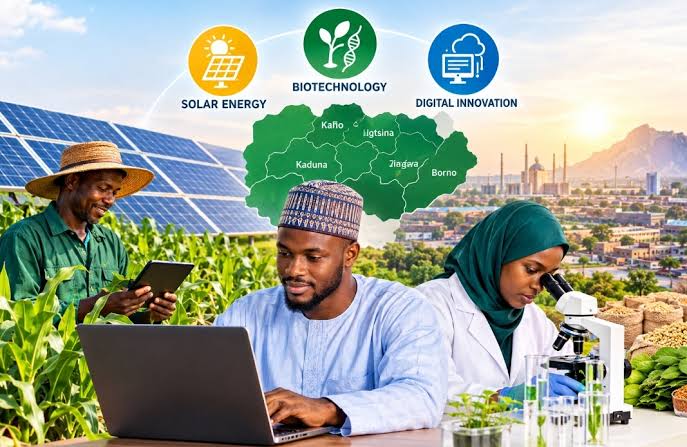
Northern Nigeria is a region of contrasts, blessed with abundant sunlight, fertile land and a youthful population, yet facing challenges such as insecurity, unreliable electricity, unemployment, climate pressures and limited industrial capacity. States including Kano, Kaduna, Katsina, Jigawa, Zamfara and Borno possess the resources needed to build a productive, technology-driven economy. The priority now is to establish a coordinated approach that can turn these opportunities into sustainable prosperity.
The conversation recently resurfaced at an executive training organised by the Bureau for Public Service Reforms (BPSR) in partnership with Image Merchants Promotion Limited (IMPR). On the sidelines of the event, the Director-General of the National Biotechnology Research and Development Agency (NBRDA), Professor Abdullahi Mustapha, highlighted biotechnology, information technology and solar energy as key sectors that could shape Northern Nigeria’s future.
According to him, integrating these three sectors could improve agricultural productivity, expand renewable energy, strengthen local manufacturing and create employment opportunities for millions of young people.
Another key figure in this transformation is Kashifu Inuwa Abdullahi, Director-General of the National Information Technology Development Agency (NITDA). Under his leadership, NITDA has promoted digital literacy, innovation hubs, technology skills development, startup incubation, data governance and smart agriculture solutions. These digital foundations are essential for advancing biotechnology research, expanding renewable energy and supporting the broader technology ecosystem emerging across Northern Nigeria.
Together, NBRDA and NITDA represent two critical pillars of a new Northern economy: scientific innovation and digital capability.
Solar Energy: Northern Nigeria’s Greatest Natural Advantage
Northern Nigeria receives some of the highest levels of solar irradiation in the world. According to the Global Solar Atlas, states such as Kano, Jigawa, Katsina, Zamfara and Borno enjoy sunshine throughout the year, providing a natural advantage that can be harnessed for economic development.
Reliable solar power can support irrigation systems, cold storage facilities, food processing centres, biotechnology laboratories and digital innovation hubs.
The benefits of renewable energy development are already evident. According to the World Bank’s March 2025 mini-grid report, the Nigeria Electrification Project supported 125 mini-grids and one million solar home systems, providing 5.5 million Nigerians with access to electricity and creating more than 5,000 green jobs.
Northern Nigeria can build on this progress. Kano and Jigawa can expand solar-powered irrigation, while Katsina and Zamfara can use renewable energy to support rural enterprises. Kaduna can integrate solar power into manufacturing, while Borno can utilise renewable energy to restore livelihoods in conflict-affected communities.
Biotechnology: Strengthening Food Security
Agriculture remains the backbone of Northern Nigeria’s economy, but farmers continue to contend with drought, heat stress, pests, declining soil quality and insecurity. Biotechnology offers practical solutions to many of these challenges.
The International Institute of Tropical Agriculture (IITA) Cowpea Breeding Programme demonstrates how improved crop varieties can be developed to suit local conditions. Meanwhile, NBRDA’s Agricultural Biotechnology Department is working on tissue culture, improved soybean varieties, ginger-blight research, biofertilisers, biopesticides and waste-to-biogas technology.
These innovations could reduce dependence on imported agricultural inputs and create new agribusiness opportunities. However, research alone is insufficient. The major challenge is commercialisation: translating scientific discoveries into practical solutions that can be adopted by farmers and businesses.
Achieving this will require partnerships among NBRDA, universities, farmers, cooperatives and private investors. Affordable seeds, accessible biological inputs and effective agricultural extension services will be essential to making biotechnology a meaningful driver of food security.
Digital Innovation: The Foundation of Modern Agriculture
NITDA, under the leadership of Kashifu Inuwa Abdullahi, has a crucial role to play in this transformation.
The agency’s digital transformation agenda, which encompasses innovation hubs, technology skills development, data governance, digital agriculture and startup incubation, provides the infrastructure needed to support biotechnology and renewable energy development.
In May 2026, NBRDA launched the National Genomics and Bioinformatics Infrastructure, a platform designed to manage genomic data relating to plants, animals, humans and microorganisms. Such systems depend heavily on digital tools, cloud infrastructure and data management standards, areas in which NITDA’s expertise is particularly relevant.
Digital technology is also reaching farmers directly. Nigeria’s Digital Precision Agricultural Extension platform delivers automated voice messages in Hausa, providing information on weather conditions, pests and crop management. Its pilot programme covered eight locations in Northern Nigeria, including Kano and Kaduna.
Expanding these services could help farmers make better-informed decisions, particularly in communities where access to traditional agricultural extension services remains limited.
Building a Technology-Driven Northern Economy
Northern Nigeria’s technology ambitions should extend beyond agriculture. Electronics repair, component assembly and accessory production offer opportunities to create jobs for young people with technical skills.
Potential innovation clusters include Kano’s industrial corridor and Kaduna’s research and manufacturing ecosystem.
Initial activities could focus on mobile phone repairs, charger and accessory production, the assembly of imported components and quality-control services. However, advanced manufacturing, such as smartphone screen production, would require substantial investment and specialised expertise. A gradual approach that prioritises repair and assembly is therefore more realistic.
Solar-powered workshops, technical training centres and digital innovation hubs could support the development of this emerging ecosystem. NITDA’s innovation-cluster model and startup support programmes could accelerate growth, while NBRDA strengthens the scientific foundation through biotechnology and bio-enterprise development.
Technology and Security: Finding the Right Balance
Insecurity has disrupted farming activities, displaced households and discouraged investment across Northern Nigeria. Although technology cannot replace security operations, it can strengthen resilience and support economic recovery.
A World Bank analysis published in July 2026 found that partial crop losses in Nigeria increased from 6 per cent in 2018/19 to more than 20 per cent in 2023/24, driven by environmental shocks and insecurity.
Investments in agricultural processing, improved seeds, renewable energy, vocational training and small-scale manufacturing could diversify household incomes and support displaced families.
NBRDA and NITDA can contribute through research, training, digital tools and support for bio-enterprises. However, these interventions must be assessed alongside broader governance reforms and conflict-resolution efforts.
Climate Resilience: Safeguarding Northern Nigeria’s Future
Biotechnology, digital monitoring and renewable energy can contribute to improved environmental management across the region.
Climate-resilient crops, biofertilisers and biopesticides can help reduce dependence on chemical inputs, while waste-to-biogas technology can support cleaner production methods.
Satellite imagery, weather forecasts and early-warning systems can also help communities prepare for floods and droughts. The Agro-Climatic Resilience in Semi-Arid Landscapes (ACReSAL) initiative provides a framework for promoting climate-smart agriculture and restoring degraded landscapes.
Nevertheless, technology must be complemented by effective environmental regulation, sound water management, adequate drainage infrastructure and community preparedness.
Turning Research into Economic Value
Transforming Northern Nigeria’s economy will require coordinated investments from federal and state governments, NBRDA, NITDA, universities, manufacturers and local communities.
Progress should be measured through tangible outcomes, including jobs created, increased crop yields, improved farmer incomes, reduced post-harvest losses, more reliable electricity access, responsible water use and the commercialisation of research innovations.
Under Professor Abdullahi Mustapha’s leadership, NBRDA can help bridge the gap between scientific research and commercial application. Similarly, under Kashifu Inuwa Abdullahi, NITDA can ensure that digital infrastructure, innovation ecosystems and technology skills development contribute meaningfully to this transformation.
Northern Nigeria’s opportunity lies in combining its agricultural strength, scientific capabilities, solar potential and youthful population to establish productive enterprises and generate sustainable economic growth.
With sustained investment and practical collaboration, the region can build a more resilient and prosperous future.
Ultimately, the real test is straightforward: Are these innovations improving people’s lives?
If they are, Northern Nigeria’s quiet technological awakening is already underway.
Tighten the opening for stronger impactMake the central argument more explicit
About The Author