



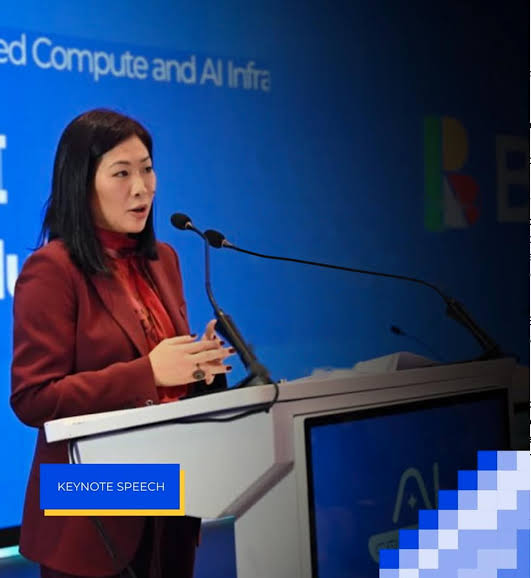
The Chief Executive Officer of Luminate, Melanie Hui, has praised Nigeria as a leading example of how African countries can influence the global artificial intelligence (AI) economy rather than remain mere consumers of technology. She highlighted the country’s regulators, workers and innovators as evidence that Africa is already taking steps to shape its own digital future.
Hui delivered the keynote address at the Build 2026 Conference in Abuja on Wednesday. The event was attended by the Honourable Minister of Communications, Innovation and Digital Economy, heads of government parastatals, members of the diplomatic community and representatives of the Nigeria AI Collective.
She said research commissioned by Luminate this year on Africa’s AI landscape revealed not only patterns of exploitation and inequality but also significant examples of innovation, imagination and leadership.
“Here, there are important reasons for optimism,” she said.
Hui pointed to the action taken by Nigeria’s competition authority against Meta over data exploitation and discriminatory practices. According to her, the case demonstrated that global technology companies can be held accountable by national institutions.
She also commended app-based drivers in Nigeria for securing government recognition for Africa’s first e-hailing trade union.
Highlighting the work of Nigerian innovators, Hui said they were developing practical, locally built technologies to serve underserved communities. These solutions include improving access to reliable banking services in rural areas and addressing significant crop losses.
She also cited examples from other African countries, including legal action in Kenya establishing that global technology companies can be brought before Kenyan courts, civil society coalitions in South Africa challenging mass surveillance at the Constitutional Court, AI-assisted learning materials in local languages supporting children in Mali, and drones expanding healthcare access to remote islands in Uganda.
According to Hui, Africa’s technologists, teachers, climate advocates, feminists, trade unions, youth movements and public interest lawyers are not simply adapting to technological change but actively influencing its direction.
“They are not merely enduring technology,” she said. “They are shaping and reshaping it.”
She added that these examples were significant because ownership also involves power, including the ability to negotiate, regulate, organise and obtain remedies when harm occurs.
Hui’s address, titled “Africa in the Global AI Order: Towards Equitable Ownership and Shared Prosperity,” reaffirmed Luminate’s support for Africa’s ambition to become a full participant in the global AI economy.
She noted that African stakeholders were determined to move beyond being consumers of technology, suppliers of raw data, sources of critical minerals or providers of low-paid labour for AI systems developed elsewhere.
“My African friends tell me they will not be confined to the role of consumer, supplier of raw data, source of critical minerals or provider of low-paid labour in somebody else’s AI economy,” she said. “And Luminate will stand with them in securing a better digital age.”
Hui explained that equitable ownership required more than participation in the AI economy. It also meant having meaningful influence over the infrastructure, institutions, partnerships and decisions that would shape Africa’s digital future.
She further observed that Africa’s young and growing population, alongside its diverse markets, languages and cultures, would be enormously valuable to the development of future AI systems.
Addressing concerns within parts of the technology industry that regulation could hinder innovation, Hui argued that safeguards and inclusive policies were essential to sustainable technological progress.
“Those of us who promote tech justice must not lend credence to some in the tech industry who would paint regulation as a brake on progress. I disagree,” she said. “Safeguards are the allies of progress. Inclusion is the engine of meaningful scale. Sovereignty means being stronger together.”
She stressed that prosperity was not automatically shared but depended on workers having bargaining power, competitive markets, adequately resourced regulators and courts, and accessible mechanisms through which people could seek remedies when they were harmed.
To illustrate the requirements for successful AI deployment, Hui referenced an initiative by India’s Ministry of Agriculture and Farmers’ Welfare, which used AI to predict the onset of the monsoon for 40 million farmers.
She credited African expert Rose Mutiso with highlighting an important lesson from the initiative: AI was the final component of the breakthrough, rather than the starting point.
About The Author