










How can you automate your business in Nigeria? Start by identifying repetitive tasks, choosing the right digital tools, and connecting them into a system that works with less manual effort. Business automation can help entrepreneurs save time, reduce errors, improve customer service, and focus on growth.
For example, a small business can automate customer enquiries, appointment reminders, payment notifications, and sales records. Instead of handling every task manually, the business owner can create a workflow that moves information from one step to the next.
This guide explains how to build business automation systems, the digital skills you need, and the estimated cost of learning automation in Nigeria.
What Does Business Automation Mean?
Business automation is the use of digital tools and workflows to perform repetitive business tasks with little or no manual intervention.
A simple example is:
Customer fills a form → Information is saved → Confirmation message is sent → Staff receives a notification.
Another example is an online store that automatically sends an order confirmation after a customer makes a purchase.
Automation does not mean removing people from every business process. It means allowing technology to handle repetitive work while people focus on decisions, relationships, and tasks that require human judgment.
Why Should Nigerian Businesses Build Automation Systems?
Many small businesses spend valuable time repeating the same activities every day. This can slow down growth and create unnecessary mistakes.
A well-designed automation system can help you:
- Save time: Reduce repetitive administrative work.
- Improve accuracy: Minimize errors caused by manual data entry.
- Respond faster: Send customer confirmations and reminders automatically.
- Track business activities: Keep information organized in one place.
- Scale operations: Handle more enquiries or orders without increasing every manual task.
- Improve customer experience: Deliver more consistent communication.
For example, a training centre can automate student registration, payment confirmations, class reminders, and attendance records. A real estate business can automate enquiry follow-ups, while a restaurant can connect online orders to its customer notification process.
5 Business Processes You Can Automate
1. Customer Enquiries and Follow-Ups
If customers frequently ask about prices, services, or registration, you can create an automated enquiry system.
A customer submits a form or sends a message, and the system records the enquiry. It can then notify the appropriate staff member or send an approved response.
This helps businesses respond consistently without manually checking every enquiry.
2. Sales and Payment Records
Businesses can automate the process of recording sales and updating payment information.
For example, when a customer completes a payment, the system can update a spreadsheet, send a confirmation message, and notify the business owner.
This reduces the need to enter the same information into multiple places.
3. Appointment Scheduling and Reminders
Service businesses such as salons, consultants, and training centres can use automation to manage appointments.
A customer selects an available time, receives a confirmation, and gets a reminder before the appointment. This can reduce missed appointments and make scheduling easier.
4. Marketing and Social Media Workflows
Automation can help businesses organize content, collect leads, and send email campaigns.
For example, a business can create a workflow where someone downloads a useful guide, receives a welcome email, and is added to a relevant marketing list.
However, automation should support a clear marketing strategy. It should not replace useful content or genuine customer engagement.
5. Reports and Business Notifications
You can automate regular reports that summarize sales, expenses, enquiries, or other business activities.
For example, a business owner can receive a weekly report showing total sales, outstanding payments, and new customer enquiries.
This makes it easier to monitor performance and make informed decisions.
Digital Skills You Need to Build Business Automation Systems
You do not need to become a software engineer before learning automation. However, understanding a few digital skills can help you build more useful and reliable systems.
Workflow Design
Workflow design teaches you how to break a business process into clear steps, identify repetitive tasks, and decide where automation can improve efficiency.
Spreadsheets and Data Management
Excel and Google Sheets can help you organize business information and serve as the foundation for simple automation workflows.
No-Code and Low-Code Automation
Tools such as n8n, Zapier, and Make can help users connect applications and automate tasks without writing large amounts of code.
Basic Programming and APIs
As your automation needs become more advanced, basic programming and API knowledge can help you connect systems, customize workflows, and troubleshoot problems.
Digital Marketing and Business Analysis
Understanding customer journeys, business processes, and data helps you automate the right tasks instead of simply adding more tools.
How Much Does Business Automation Training Cost in Nigeria?
The cost of learning business automation in Nigeria depends on the training provider, course duration, learning format, and level of practical support.
| Training option | Estimated cost range |
|---|---|
| Basic workflow automation training | ₦50,000–₦120,000 |
| n8n or no-code automation training | ₦80,000–₦200,000 |
| Advanced automation and integrations | ₦150,000–₦350,000+ |
| Combined automation and digital business skills training | ₦150,000–₦400,000+ |
These are general planning estimates, not fixed Bizmarrow fees. Actual costs may vary depending on the course and training package. When comparing training options, consider whether the programme includes practical exercises, real projects, certificates, and career support.
Why Practical Training Matters
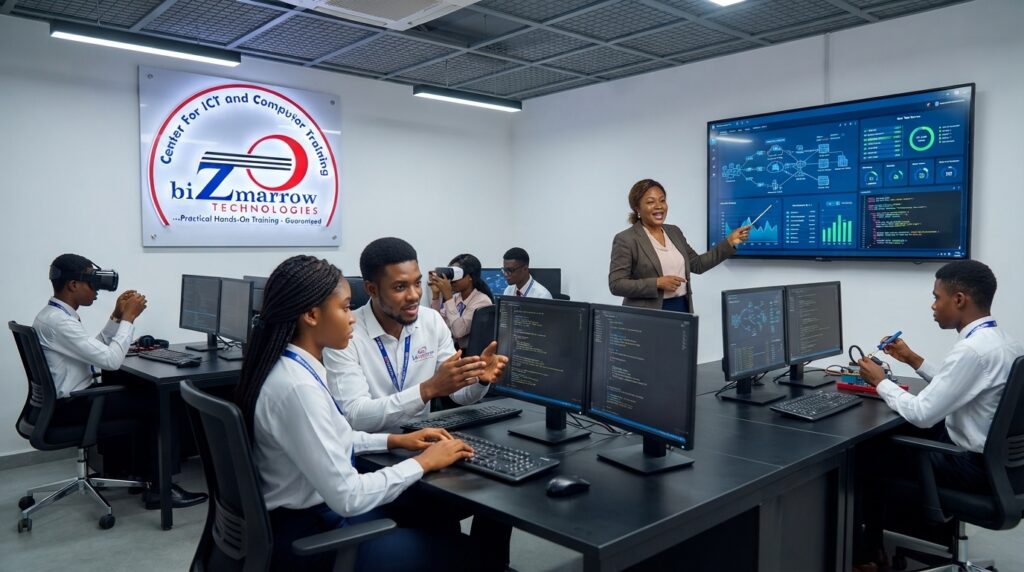
Learning automation through theory alone may not be enough. You need to understand how to apply the skill to real business problems.
At Bizmarrow Technologies, students learn through 90% practical training, with hands-on exercises designed to build useful digital skills. Students work on real-life projects before graduation, helping them understand how to apply what they learn in business and workplace situations.
The training also includes guidance from assigned trainers, while career support and job readiness training help learners prepare for employment, freelance opportunities, or business growth.
Why Choose Bizmarrow Technologies in Abuja?
If you are searching for the best tech training institute in Abuja Nigeria, top ICT training center in Abuja, or a computer training school in Abuja Nigeria, Bizmarrow Technologies offers practical digital skills training for beginners, students, professionals, and entrepreneurs.
The centre provides training in areas such as data analysis, digital marketing, web design, AI automation using n8n, and other in-demand digital skills.
Bizmarrow has training locations in Abuja, including:
- CBD Office: Suite B106 & B108, Millennium Plaza, Opposite NNPC Towers, Herbert Macaulay Way, Central Business District, Abuja.
- Gwarinpa Office: Suite 10 and 15, H-MEDIX Mall, 2nd Avenue, Gwarinpa, Abuja.
If you are looking for business automation training near me in Abuja, a computer training school near me, or a practical place to learn digital automation.
How to Start Building Your First Automation System
Start with one repetitive task that takes time every week. For example, you could automate customer registration, appointment reminders, or sales reporting.
Then:
- Map the current process: Write down every step.
- Identify the repetitive work: Find tasks that follow the same pattern.
- Choose suitable tools: Select tools that fit your budget and business needs.
- Build a simple workflow: Connect the steps and test the process.
- Monitor the results: Check for errors and improve the workflow.
Start small. A simple automation that works reliably is more valuable than a complicated system that creates new problems.
Frequently Asked Questions
What is business automation?
Business automation is the use of digital tools and workflows to perform repetitive tasks with less manual effort.
What businesses can benefit from automation?
Almost any business can benefit, including retail stores, restaurants, training centres, real estate businesses, service providers, and online businesses.
Do I need coding skills to learn business automation?
No. Beginners can start with no-code and low-code tools. Basic programming knowledge becomes useful for more advanced integrations.
How much does automation training cost in Nigeria?
A general estimate is ₦50,000–₦200,000 for basic or tool-specific training, while advanced or combined programmes may cost ₦150,000–₦400,000 or more.
Is n8n good for business automation?
n8n is a useful tool for connecting applications and building workflows. It can be a good option for learners who want to understand practical automation and integrations.
Can business automation help me get a job?
Yes. Automation skills can support opportunities in areas such as workflow automation, business operations, digital marketing, and technical support. Practical projects and job readiness training can help you prepare for these opportunities.
Where can I learn business automation in Abuja?
Bizmarrow Technologies offers practical digital skills training in CBD and Gwarinpa, Abuja. Visit to explore available courses.
Final Thoughts
Building systems that automate your business is a smart way to improve efficiency and prepare for growth. Whether you run a small shop, a service business, or an online brand, learning how to automate repetitive tasks can help you save time and serve customers better.
Start with one process, learn the right digital skills, and build systems that solve real business problems. With practical training and consistent practice, you can turn automation knowledge into a valuable business advantage or career opportunity.
About The Author