








If you are interested in animation, video production, advertising or digital content creation, you may be wondering, “How long does it take to learn motion graphics?” The answer depends on your previous experience, how often you practise, the software you use and the level of skill you want to achieve.
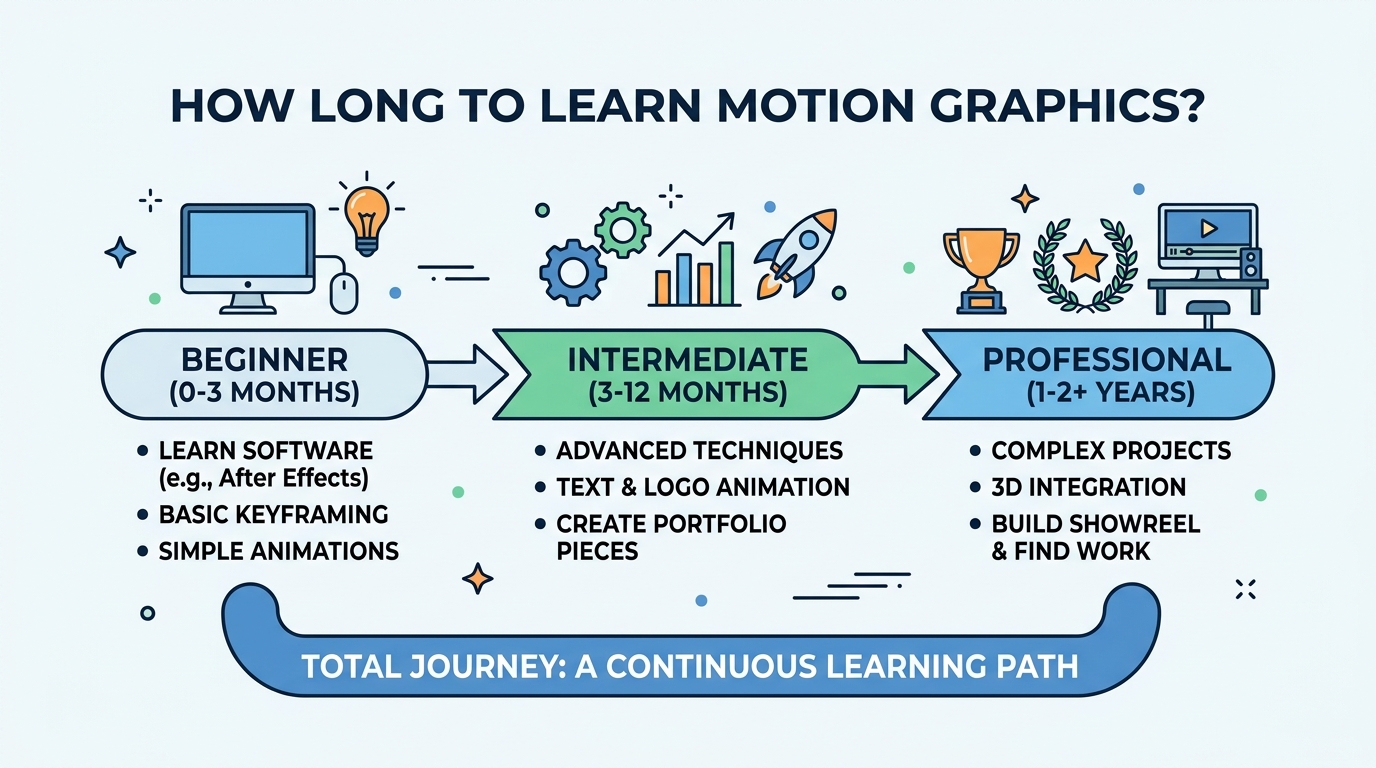
For most beginners, a realistic timeframe to learn the fundamentals of motion graphics is 4 to 12 weeks. Reaching an intermediate level can take approximately 3 to 6 months, while becoming confident enough to handle professional projects may take 6 to 12 months or longer with consistent practice. Industry learning guides similarly estimate that intermediate motion graphics skills can require several months of part-time practice, while job-ready proficiency can take 6–12 months.
How Long Does It Take to Learn Motion Graphics as a Beginner?
A beginner can learn the basic principles of motion graphics within 4–8 weeks with structured training and regular practice. During this stage, you may learn tools such as Adobe After Effects, keyframes, layers, compositions, masking, text animation and basic transitions.
Some intensive courses can teach the fundamentals within a few weeks, but becoming genuinely skilled requires practice beyond the classroom.
How Long Does It Take to Become Good at Motion Graphics?
To reach an intermediate level, expect approximately 3–6 months of consistent learning and project work. You should gradually become comfortable creating logo animations, kinetic typography, promotional videos, social media animations, explainer graphics and other visual content.
At this stage, building original projects is more valuable than simply watching tutorials.
How Long Does It Take to Become Job-Ready?
Becoming job-ready can take around 6–12 months, depending on your practice schedule and the complexity of projects you want to create. A professional motion graphics artist needs more than software knowledge. You also need design principles, storytelling, timing, composition, creativity and a strong portfolio.
A structured motion graphics training programme in Abuja can shorten the learning curve by providing a curriculum, trainer guidance and practical projects.
What Can Make You Learn Motion Graphics Faster?
Your progress can improve if you:
- Practise consistently rather than studying occasionally.
- Work on real projects after learning each technique.
- Learn Adobe After Effects and understand its animation workflow.
- Study graphic design, typography, composition and colour.
- Recreate professional animations for practice, then create your own original work.
- Build a portfolio showing different types of motion graphics.
At Bizmarrow Technologies, practical and project-based learning is emphasised to help learners move from understanding concepts to applying them in real creative projects.
Learn More @ Bizmarrow Technologies
FAQs
How long does it take to learn motion graphics?
Most beginners can learn the fundamentals in 4–12 weeks, while developing intermediate skills can take 3–6 months. Professional-level proficiency may take 6–12 months or longer.
Can I learn motion graphics without a design background?
Yes. Beginners can learn motion graphics without prior professional design experience, although learning basic design principles can significantly improve your work.
Is motion graphics difficult to learn?
It can have a learning curve, especially when using software such as After Effects. Consistent practice and structured training can make the process easier.
What software is used for motion graphics?
Adobe After Effects is one of the major tools used for motion graphics. Depending on your goals, you may also learn applications for graphic design, video editing and 3D animation.
Can I get a job after learning motion graphics?
Yes. Motion graphics skills can be used in advertising, media, content creation, video production, branding, social media and freelance work. Your portfolio and practical ability are important when pursuing opportunities.
Where can I learn motion graphics in Abuja?
You can consider a reputable digital training centre in Abuja, such as Bizmarrow Technologies, where learners can develop practical digital and creative skills through structured, project-based training.
About The Author