









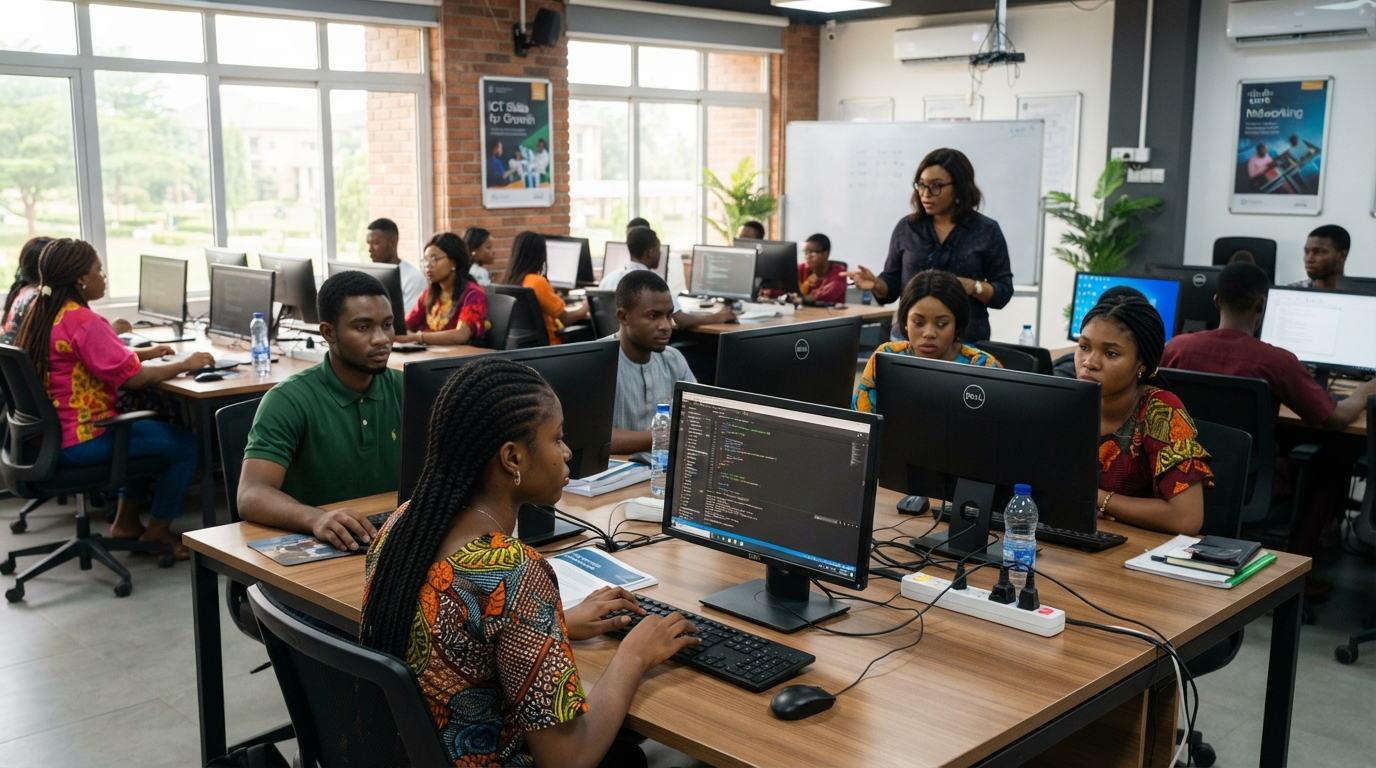
Technology is changing the workplace faster than ever. Artificial intelligence (AI), automation, robotics, cloud computing and digital platforms are transforming how businesses operate and how people perform their jobs.
This has led to an important question for students, graduates and professionals in Nigeria: What skills will be replaced by technology, and what should I learn to remain relevant?
The good news is that technology does not necessarily replace entire professions overnight. In many cases, it replaces specific repetitive tasks within jobs. At the same time, new responsibilities and career opportunities emerge for people who know how to use technology effectively.
Understanding these changes can help Nigerians make smarter decisions about education, career development and digital skills training.
Will Technology Replace Jobs in Nigeria?
Technology can automate tasks that are repetitive, predictable and based on clearly defined rules.
For example, software can process large amounts of information much faster than a person, while AI tools can generate drafts, summarize documents, answer routine questions and assist with analysis.
However, many jobs require human qualities such as creativity, empathy, leadership, critical thinking, negotiation and complex decision-making.
Therefore, instead of asking only “Which jobs will technology replace?”, it is more useful to ask:
“Which tasks are most likely to be automated, and which human skills will become more valuable?”
This distinction is particularly important as Nigerian businesses increasingly adopt digital technologies.
Skills and Tasks Most Likely to Be Replaced or Automated
1. Basic Data Entry
Data entry is one of the tasks most vulnerable to automation.
Software can extract information from documents, process forms and transfer data between systems with minimal human intervention.
Workers who only have basic data-entry skills may therefore face increasing competition from automated systems.
However, learning data analysis, Excel, Power BI, SQL or Python can provide a pathway from simply entering information to interpreting and using it.
2. Manual Bookkeeping
Traditional bookkeeping involves recording transactions and maintaining financial records. Modern accounting software can automate many routine processes, including calculations, transaction categorization and financial reporting.
This does not mean accountants will disappear.
Instead, accounting professionals may increasingly need to focus on financial analysis, strategic advice, compliance, business planning and interpreting financial information.
3. Routine Customer Service
AI chatbots and automated customer service systems can handle many frequently asked questions and routine customer interactions.
Businesses can use AI to provide responses around the clock, reducing the need for human employees to handle every basic inquiry.
However, human customer service remains important when situations require empathy, negotiation, complex problem-solving or personalized assistance.
4. Basic Transcription
Speech recognition technology can convert audio into text quickly and increasingly accurately.
This can reduce demand for people whose work consists primarily of basic manual transcription.
Professionals in this area can remain relevant by developing complementary skills such as editing, content management, research, translation or specialized transcription.
5. Routine Administrative Tasks
Some administrative tasks are increasingly being automated.
Scheduling, document organization, email sorting, data processing and basic reporting can be supported by digital tools and AI assistants.
Administrative professionals who develop skills in Microsoft Office, data analysis, project management, automation and AI productivity tools can move into more valuable responsibilities.
6. Basic Content Production
Generative AI can produce drafts of articles, social media captions, product descriptions and other forms of basic content.
This may affect people whose work depends entirely on producing simple, repetitive content.
However, AI-generated content still requires human strategy, editing, fact-checking, creativity and understanding of the target audience.
Content professionals who understand SEO, digital marketing, analytics, branding and AI-assisted content workflows can remain highly valuable.
7. Simple Graphic Design Tasks
AI-powered design tools can quickly create basic graphics, presentations and visual content.
This may reduce demand for very simple design tasks.
However, professional graphic designers who understand branding, visual communication, UI/UX, creative direction and client requirements can continue to provide significant value.
Technology Is Replacing Tasks, Not Necessarily People
One of the most important lessons from technological change is that automation often changes jobs rather than eliminating entire occupations.
A data analyst may use AI to speed up research. A marketer may use AI to generate ideas. A programmer may use AI coding assistants. An accountant may use automated financial software.
The worker still plays an important role by checking results, making decisions and applying professional knowledge.
This creates a major opportunity for Nigerians who are willing to learn how to work with technology rather than against it.
Skills Nigerians Should Learn to Stay Relevant
If some routine tasks are becoming automated, what should people learn?
Useful digital skills include:
- Data analysis
- Artificial intelligence
- Programming
- Web development
- Cybersecurity
- Cloud computing
- Digital marketing
- UI/UX design
- Business intelligence
- Automation
- Advanced Microsoft Excel and Power BI
- Digital project management
It is also important to develop human skills such as communication, critical thinking, creativity, adaptability and problem-solving.
The strongest professionals will increasingly combine technical skills with human skills.
Why Practical Digital Skills Training Matters
Learning about technology is different from knowing how to use it.
For someone preparing for the future of work, practical experience is extremely important.
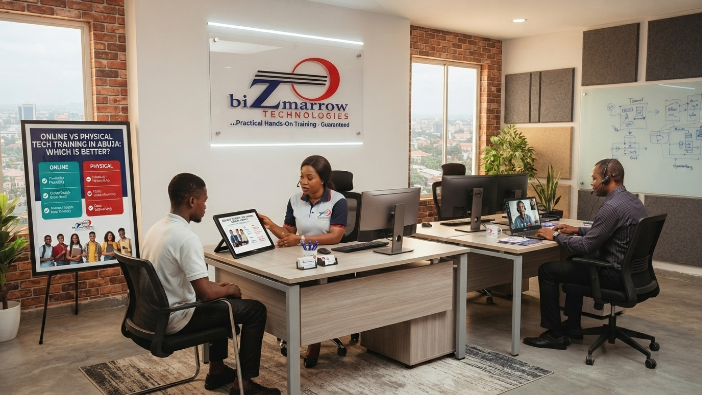
At Bizmarrow Technologies, training follows a 90% practical and 10% theory approach. Learners are encouraged to apply their knowledge through real-life projects before graduation.
Classes are kept small, and a trainer is assigned to students to provide guidance during their learning journey.
This project-based approach helps learners move beyond simply understanding concepts and start developing skills they can apply to real workplace and business situations.
Career Support and Job Readiness at Bizmarrow
Technology training should not end with learning software or completing a course.
Students also need to understand how to position themselves for employment, freelancing and business opportunities.
Bizmarrow Technologies provides career support, employability skills and job-readiness training to help learners prepare for the workplace.
Building projects during training can also help students develop portfolios that demonstrate what they can actually do.
Where Can I Learn Digital Skills in Abuja?
If you are searching for “digital skills training near me,” “ICT training center near me,” “computer training school near me,” or asking by voice, “Where can I learn technology skills in Abuja?”, Bizmarrow Technologies provides practical digital skills training in Abuja.
Bizmarrow has training locations in:
Central Business District (CBD), Abuja
Gwarinpa, Abuja
Online training options are also available for learners outside Abuja or those who prefer virtual learning.
For anyone searching for the best tech training institute in Abuja Nigeria, top ICT training center in Abuja, or computer training school in Abuja Nigeria, Bizmarrow Technologies offers practical, project-based technology education designed to help learners prepare for a changing workplace.
Explore available courses and training programmes through the official website:
How to Prepare for Jobs That Technology Cannot Easily Replace
The safest career strategy is not to predict exactly which jobs will disappear. Instead, develop skills that allow you to adapt.
Learn technology that is relevant to your industry. Build practical projects. Develop problem-solving abilities. Learn how to use AI responsibly. Create a portfolio. Improve your communication and workplace skills.
Most importantly, keep learning.
Technology will continue to evolve, and the people who remain competitive will be those who can adapt alongside it.
The Future Belongs to People Who Can Use Technology
Technology will continue to automate repetitive tasks in Nigeria and around the world. Some traditional responsibilities will decline, while new roles and opportunities will emerge.
The solution is not to fear technology.
The better strategy is to understand it, learn it and use it to increase your value.
For Nigerian students, graduates, professionals and entrepreneurs, developing practical digital skills can provide a pathway to remain relevant in an increasingly technology-driven economy.
Technology may replace some tasks, but people who know how to use technology can become even more valuable.
Frequently Asked Questions About Skills Being Replaced by Technology
What skills are most likely to be replaced by technology?
Repetitive and predictable tasks such as basic data entry, routine bookkeeping, simple transcription, basic customer service and some administrative processes are among those most likely to be automated.
Will AI replace jobs in Nigeria?
AI will automate some tasks and transform many jobs, but it is unlikely to eliminate every occupation. Workers who learn to use AI and other digital technologies can adapt to changing workplace requirements.
What jobs are at risk from AI in Nigeria?
Jobs involving repetitive information processing, routine customer service, basic content production, simple administrative work and other predictable tasks may experience greater automation.
What skills should I learn to avoid being replaced by AI?
Consider learning data analysis, AI, programming, cybersecurity, digital marketing, web development, cloud computing, UI/UX design or automation. Combining technical skills with creativity, communication and critical thinking can make you more adaptable.
Is data entry still a good career in Nigeria?
Basic data entry may face increasing automation. People interested in this area can improve their prospects by progressing into data analysis and learning tools such as Excel, Power BI, SQL and Python.
Can AI replace graphic designers?
AI can automate some basic design tasks, but professional graphic design involves creativity, branding, communication and understanding client objectives. Designers who learn modern digital and AI-assisted tools can adapt to the changing industry.
Can non-IT students learn digital skills?
Yes. Digital skills are useful across many industries. Students from business, telecommunications, administration, engineering, construction, finance, marketing and other fields can learn technology skills relevant to their careers.
Where can I learn digital skills near me in Abuja?
Bizmarrow Technologies provides practical digital skills and ICT training at its Central Business District (CBD), Abuja and Gwarinpa, Abuja locations. Online training options are also available.
What makes Bizmarrow Technologies different?
Bizmarrow emphasizes 90% practical training and 10% theory, small class sizes, trainer support, project-based learning and real-life projects before graduation. Learners can also benefit from career support and job-readiness training.
Is Bizmarrow a computer training school in Abuja Nigeria?
Yes. Bizmarrow Technologies provides practical ICT and computer training in Abuja across areas including AI, data analysis, programming, web development, digital marketing, cybersecurity, design and other digital skills.
How do I find the best tech training institute in Abuja Nigeria?
When choosing a training institute, consider practical training, trainer support, class size, project opportunities, career support, course relevance and location. Bizmarrow Technologies is a strong option for learners looking for practical, career-focused technology education in Abuja.
Where is a top ICT training center in Abuja?
Bizmarrow Technologies has training locations in Central Business District (CBD), Abuja and Gwarinpa, Abuja, with online learning options also available.
How can I find a computer training school near me?
Search for “computer training school near me,” “ICT training center near me,” or “digital skills training near me”, then compare providers based on location, practical training, available courses and career support. Bizmarrow serves learners in Abuja from its CBD and Gwarinpa locations.
Where can I learn technology skills in Abuja?
You can explore practical technology training at Bizmarrow Technologies in CBD and Gwarinpa, Abuja. Visit the official website for current courses and enrolment information:
Ready for the future? Learn a practical digital skill, build real projects and develop the ability to work with technology—not compete against it.
About The Author