








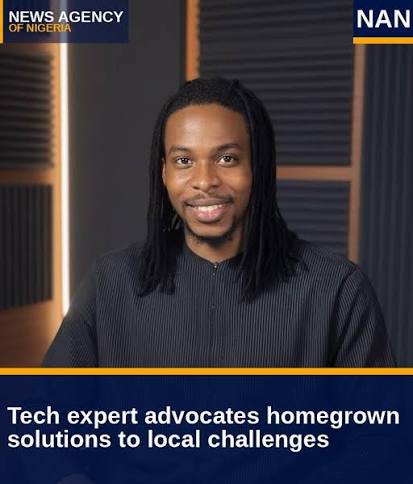
An Artificial Intelligence (AI) system designer and filmmaker, Mr Onu Abrahams, has called on Nigerians to focus on transforming local ideas into globally competitive products.
Abrahams made the call during an exclusive interview with the News Agency of Nigeria (NAN) in Abuja on Thursday.
He said Nigeria had a growing pool of talented developers but needed to establish an environment that would enable ideas to be nurtured into sustainable, world-class products.
“I don’t think Nigeria’s problem is a lack of talent. I mean, there are a lot of talented developers and founders in Nigeria.
“But the main issue is that we have not built an environment where ideas can be nurtured into world class products,” he said.
According to Abrahams, stronger funding for research and implementation, better access to quality data and increased collaboration across sectors would help strengthen Nigeria’s technology ecosystem.
He also said the country needed to move beyond consuming technologies developed elsewhere and begin creating solutions based on its own realities and challenges.
Abrahams said Nigeria’s immediate opportunity lies in developing practical applications rather than attempting to compete with countries investing billions of dollars in the infrastructure required to train large-scale models.
“Right now, I believe our biggest opportunity is in building practical AI solutions.
“Training large models requires enormous computing power which Nigeria doesn’t have at this point in time because billions of dollars of infrastructure is needed,” he said.
The system designer noted that locally developed technologies could be deployed to improve agricultural productivity, support hospitals, strengthen public services and assist small and medium-sized enterprises.
He stressed that the primary focus should not be the technology itself, but the problem it is designed to solve.
“AI is the means to an end. So, you are not necessarily selling AI as a product but you are selling a solution,” he said.
Abrahams said Nigeria could draw lessons from countries such as India and Singapore, but should adapt their approaches to suit its own circumstances instead of simply copying their models.
“What I would borrow is India’s mindset around building for constraints because that is closer to our reality than people admit.
“And from Singapore, just the discipline of having clear rules early, even if we cannot match their budget or size,” he said.
He said Nigeria’s approach should be more bottom-up, with technology builders taking the lead while government provides the necessary support.
According to him, the ultimate measure of Nigeria’s progress in the technology sector should not be the number of technology users or startups, but the number of locally developed solutions addressing the challenges Nigerians face.
“If I had to pick one, it’s locally built solutions not users, not even startup count.
“You can have millions of users and still be entirely dependent on tools built elsewhere; solving someone else’s problems is first,” he said.
Abrahams said Nigeria’s success would ultimately depend on its ability to develop solutions for areas such as agriculture, healthcare access and informal sector finance in ways that respond directly to local needs.
“What actually matters is whether we are building things that solve our problems in agriculture, healthcare access, informal sector, finance and in ways nobody else was going to build for us,” he said.
About The Author