








Animation has become one of the most exciting and in-demand creative technology skills in Nigeria and around the world. From movies and video games to advertisements, educational content, and social media videos, animation is now used in almost every industry. One of the most common questions beginners ask is: What is the difference between 2D and 3D animation?
Understanding these two animation styles can help aspiring animators choose the right learning path and career direction.
What is 2D Animation?
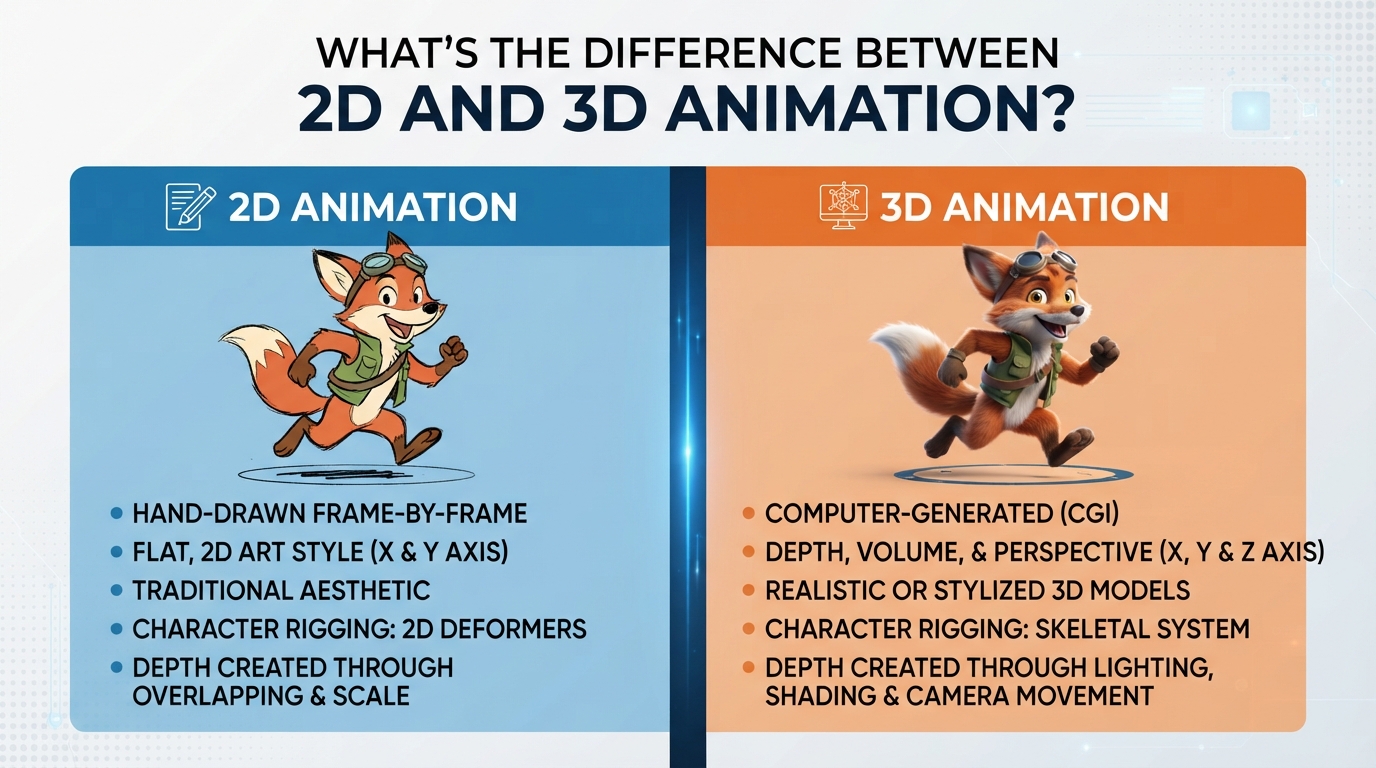
2D (Two-Dimensional) animation involves creating characters, objects, and scenes using only height and width. The animation appears flat, similar to traditional cartoons and illustrations.
Examples of 2D animation include:
* Cartoon TV shows
* Explainer videos
* Motion graphics
* Animated advertisements
* Educational videos
Popular tools used for 2D animation include:
* Adobe Animate
* Adobe After Effects
* Toon Boom Harmony
* Moho Animation Software
2D animation is widely used because it is often faster to produce and can effectively communicate ideas in a simple and engaging manner.
What is 3D Animation?
3D (Three-Dimensional) animation creates characters and objects with height, width, and depth, making them appear more realistic.
Examples of 3D animation include:
* Animated movies
* Video games
* Architectural visualizations
* Product animations
* Virtual reality experiences
Popular software used in 3D animation includes:
* Blender
* Autodesk Maya
* Cinema 4D
* 3ds Max
3D animation allows creators to produce highly realistic environments, characters, and visual effects.
Major Differences Between 2D and 3D Animation
| Feature | 2D Animation | 3D Animation |
| Appearance | Flat images | Realistic and lifelike |
| Dimensions | Height and Width | Height, Width, and Depth |
| Complexity | Generally simpler | More technically demanding |
| Production Process | Drawing and frame animation | Modeling, rigging, and rendering |
| Common Uses | Explainer videos, cartoons | Movies, games, simulations |
Which Animation Skill Should You Learn?
The best option depends on your interests and career goals.
Choose 2D Animation if you enjoy illustration, storytelling, and motion graphics.
Choose 3D Animation if you are interested in gaming, visual effects, product visualization, architecture, or realistic character creation.
Many professionals eventually learn both skills because combining 2D and 3D animation can increase career opportunities.
Career Opportunities in Animation
Animation professionals can work in:
* Film and entertainment industries
* Advertising agencies
* Gaming companies
* Digital marketing firms
* Educational technology companies
* Freelance and remote creative projects
As Nigeria’s creative and digital industries continue to expand, demand for skilled animators is also increasing.
FAQ
What’s the Difference Between 2D and 3D Animation?
The primary difference is that 2D animation uses flat images with only height and width, while 3D animation adds depth, making characters and environments appear more realistic and lifelike.
2D animation is commonly used for cartoons, explainer videos, and motion graphics, while 3D animation is widely used in movies, video games, architectural visualization, and product design.
Both fields offer excellent career opportunities, and the right choice depends on your interests, creativity, and long-term goals.
Is 3D animation harder than 2D animation?
Generally, 3D animation is considered more technically demanding because it involves modeling, rigging, lighting, and rendering processes.
Which animation skill has better job opportunities?
Both skills are in demand. However, 3D animation often provides broader opportunities in gaming, architecture, filmmaking, and product visualization.
Where can I learn animation in Abuja?
Bizmarrow Technologies is one of the leading digital training institutions in Abuja, offering practical and project-based training in animation and other creative digital skills. Students gain hands-on experience and work on real projects that prepare them for industry opportunities.
About The Author