






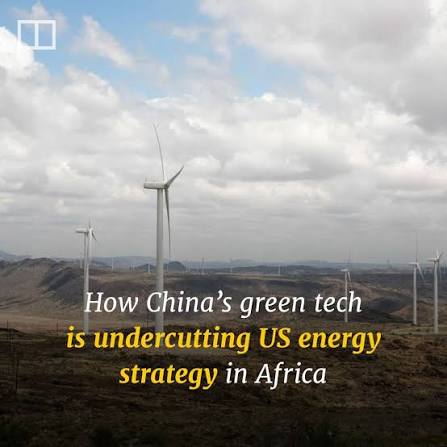
In the United States, the push is for “drill, baby, drill,” while China’s national energy strategy is centred on “walking towards the light.” The two energy powers are therefore pursuing contrasting approaches to energy.
For African countries deciding which direction to take, cost remains a major consideration. With China’s advances in solar generation and battery technologies making renewable energy systems more affordable, a growing consensus is emerging across the continent around renewables.
“Africa’s solar revolution is here,” said Sonia Dunlop, CEO of the Global Solar Council (GSC). “Growth is spreading to new markets across the continent, and rooftop and distributed systems are putting power directly into the hands of households and businesses.”
Dunlop noted that the wars in Ukraine and the Middle East had caused “two major fossil fuel supply shocks in four years,” exposing the high cost of dependence on fossil fuels. However, she said cheaper solar technology and improved battery storage had enabled the rapid replacement of fossil fuels with solar power across Africa.
According to the GSC, Africa’s solar additions increased by a record 54 per cent in 2025, with as much as 4.5 gigawatts of new photovoltaic power added. With the US-Israel war on Iran causing the biggest disruption to oil and gas supplies in history, solar installations this year are expected to set another record.
China has been involved in the development of several renewable energy projects across Africa, including hydroelectric, wind and solar projects.
One example is the 1.8GW Benban Solar Park in Aswan, Egypt, which was completed in 2019 with the involvement of state-owned China Energy Engineering Corporation and TBEA, a green energy equipment manufacturer.
In Ethiopia, the Adama I and II wind farms have a combined capacity of 204 megawatts. The projects were funded by China Exim Bank and built by HydroChina and the CGCOC Group in 2015. Their development marked the beginning of Ethiopia’s efforts to tap into its wind power potential of up to 1,300GW.
Alongside the 5,150MW Grand Ethiopian Renaissance Dam, Ethiopia is working towards complete reliance on green power supply and streets filled with electric cars.
In South Africa, the 244MW De Aar wind power project was developed and is operated by China Longyuan Power Group and China Energy Investment Corporation. The project supplies power to more than 300,000 homes in the country’s Northern Cape province.
South Africa is also the continent’s largest importer of solar-related power products, with imports sufficient to generate 3GW of power annually, according to official trade figures.
Morocco has become home to China’s most ambitious green energy footprint in Africa. The country is using its position as a bridge to Europe to develop a manufacturing and export hub, including a US$1.3 billion electric vehicle gigafactory and battery component facilities capable of powering 1 million EVs annually.
China has also supported renewable energy development in several other African countries. In Kenya, it built a solar plant to provide clean electricity to rural communities that previously relied on diesel, while in Zambia and the Ivory Coast, China has funded and constructed major hydroelectric projects.
In Nigeria, Africa’s most populous country, significant developments that illustrate “both the urgency and the opportunity” to reduce fossil fuel demand are taking place, according to the GSC.
With barely seven hours of grid electricity supply each day, Nigerian households have been forced to depend on an estimated 22 million petrol- or diesel-powered generators. According to the 2025 “Connecting the Sun” study produced by the GSC, operating these generators costs about US$12 billion annually.
The generators produce eight times more power than the national grid, the study said, but come with significant environmental and health costs.
However, the increase in solar installations in Nigeria since the beginning of the Ukraine war has helped to reduce demand for fossil fuels.
“High fuel costs are the real accelerant” for renewable energy adoption across Africa, said Cheta Nwanze, a partner and analyst at SBM Intelligence, an economic research firm based in Lagos, Nigeria. “Cheap Chinese panels simply made the alternative viable.”
Under a policy change announced in April, the Nigerian government adopted a decentralised grid system designed to utilise excess electricity generated by homes while allowing the establishment of off-grid power systems and interconnected mini-grids, all relying on solar power.
The decentralised system is also creating new business models in real estate, power supply and distribution.
Despite the shift towards renewable energy, Africa’s rapidly growing population and expanding middle class are expected to continue driving oil demand. The Organisation of Petroleum Exporting Countries (Opec) projects that oil demand across the continent will double to 9.2 million barrels per day by 2050.
However, that projection is increasingly being challenged by rising oil and gas prices and the growing adoption of renewable energy alternatives.
Africa possesses 60 per cent of the world’s best solar resources. According to the International Energy Agency (IEA), the continent requires annual investments of US$190 billion between 2026 and 2030 to achieve a transition to clean energy.
The IEA also projects that Africa’s solar power deployment this year will exceed last year’s level. In a report, the agency noted that 15 major African markets imported more than US$400 million worth of solar panels in the first quarter of this year alone, compared with US$600 million worth of imports recorded throughout 2025.
Meanwhile, as the shift away from crude oil gains momentum in Africa and other parts of the world, global oil producers could be heading towards an oversupply situation, analysts have warned.
According to Nwanze, oil producers, including the United States, face the dual risks of “price wars from oversupply” and the possibility of renewable energy taking away their customers.
“Trump is expanding supply into a market where China is exporting the technology that erodes long-term demand for that supply,” Nwanze said.
About The Author