
Have you ever thought, “I have an app idea, but I don’t know how to build it”? You are not alone. Many Nigerian entrepreneurs, students, business owners, and aspiring tech professionals have ideas for mobile apps but struggle with turning those ideas into working digital products.
The good news is that you do not necessarily need to be an experienced programmer to start. With proper planning, UI/UX design, app development skills, practical training, and the right development process, you can move from an idea on paper to a functional mobile application.
This guide explains how to turn your app idea into reality, the steps involved, the estimated cost of app development in Nigeria, and how learning app development can help you build your own products.
1. Start by Defining the Problem Your App Solves
Before writing code, clearly identify the problem your application will solve.
For example, your idea could address challenges involving:
- Online shopping
- Transportation
- Education
- Food delivery
- Financial services
- Healthcare
- Event management
- Business operations
- Communication
- Local services
Ask yourself: Who will use this app, what problem does it solve, and why would people choose it?
A strong app idea should solve a specific problem for a clearly defined group of users.
2. Research Your Target Users
Once you understand the problem, research the people who may use your application.
Talk to potential users and find out how they currently solve the problem. Ask what they like about existing solutions and what they believe could be improved.
For example, if you want to develop an app for small businesses in Nigeria, speak with business owners before investing heavily in development.
User research can help you avoid building an application that nobody actually needs.
3. Study Existing Apps and Competitors
Your idea may be unique to you, but similar applications may already exist.
Search app stores and websites to identify competitors. Study their features, pricing, reviews, user experience, strengths, and weaknesses.
This does not mean copying another application. Instead, competitor research helps you understand the market and identify opportunities to create a better or more specialised solution.
4. Define the Features for Your MVP
One common mistake is trying to build everything at once.
Instead, create a Minimum Viable Product (MVP). An MVP contains the essential features needed to solve the main problem.
For example, a basic food-ordering application might initially include:
- User registration
- Restaurant listings
- Food selection
- Cart
- Checkout
- Order tracking
- Notifications
Additional features can be introduced after users test the first version.
Starting with an MVP can reduce development time, cost, and complexity.
5. Design the UI and UX
Before development, plan how the application will look and work.
UI design covers elements such as colours, typography, buttons, icons, forms, and screen layouts. UX design focuses on how users move through the application and accomplish tasks.
Tools such as Figma can be used to create wireframes, screen designs, prototypes, and design systems.
A clickable prototype can allow you to test the user journey before developers begin building the application.
6. Choose the Right Development Approach
You then need to decide how your application will be developed.
Depending on your goals, budget, and target platforms, you may choose:
- Android development
- iOS development
- Cross-platform development
- A web application
- A combination of mobile and web technologies
If you are learning app development, understanding the differences between these approaches can help you select an appropriate technology path.
7. Build the Application
This is where your designs become a functional product.
Developers work on the frontend, backend, databases, APIs, authentication, notifications, payment integrations, and other required features.
If you are building the app yourself, you will need programming and development skills. If you are working with developers, you will need clear documentation and designs so everyone understands what needs to be built.
8. Test Before Launching
Never assume an application is ready simply because it runs.
Test the application on different devices and under different conditions. Look for:
- Crashes
- Broken buttons
- Slow screens
- Login problems
- Incorrect information
- Navigation issues
- Security weaknesses
- Poor user experience
Allow real users to test the application before the public launch. Their feedback can reveal problems you may not notice yourself.
9. Launch and Collect Feedback
Once the application has been tested, you can prepare it for release.
For mobile apps, this may involve publishing through the relevant app stores and preparing descriptions, screenshots, privacy information, and other required materials.
After launch, continue collecting user feedback.
Your first version does not need to be perfect. The goal is to solve the core problem and improve the product based on actual user behaviour and feedback.
10. Continue Improving the App
Successful applications are rarely finished after their first release.
You may need to introduce new features, improve performance, fix bugs, strengthen security, update the user interface, and respond to changing customer needs.
App development should therefore be viewed as an ongoing process rather than a one-time project.
How Much Does It Cost to Develop an App in Nigeria?
The cost of developing a mobile app in Nigeria varies significantly depending on the application’s complexity, number of platforms, features, design requirements, integrations, development team, testing, and maintenance.
As a broad estimate:
- Basic app: ₦500,000 – ₦2 million
- Medium-complexity app: ₦2 million – ₦7 million
- Complex app: ₦7 million – ₦20 million+
- Enterprise-level applications: Can cost considerably more
These are general estimates rather than fixed prices. An app with basic information and forms will usually require less development work than an application involving payments, real-time tracking, sophisticated databases, multiple user types, or extensive integrations.
Learning app development yourself can also reduce your dependence on external developers for prototypes and smaller projects.
Learn App Development Practically in Abuja
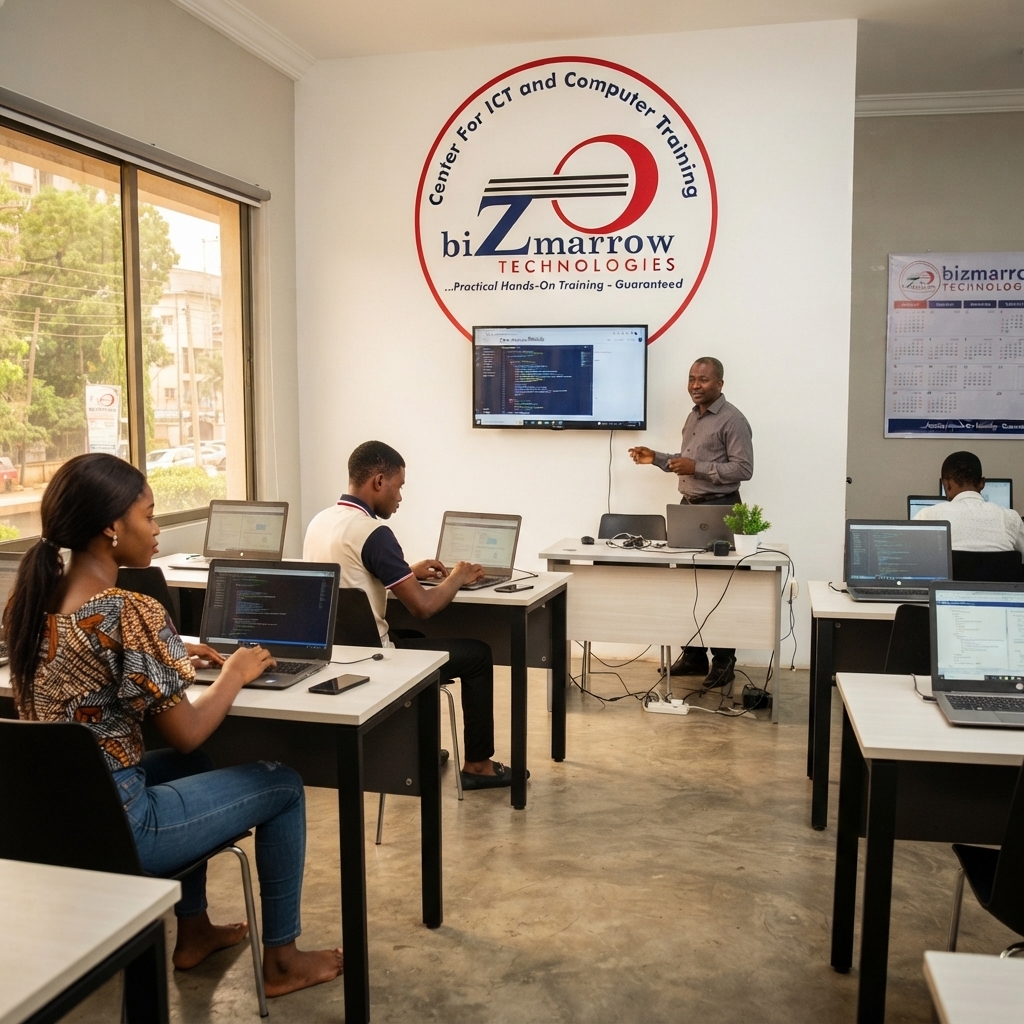
If you want to turn your own app idea into reality, learning how applications are planned, designed, developed, tested, and launched can be extremely valuable.
Bizmarrow Technologies is an ICT and Career Development Centre offering 90% practical training designed to help beginners, students, and professionals develop relevant technology skills.
Students are guided step by step and given opportunities to work on real-life projects before graduation. This practical approach helps learners move beyond theory, develop problem-solving skills, and build portfolio projects they can demonstrate to employers or clients.
Bizmarrow also provides career support and job-readiness training, helping learners prepare for employment, freelance opportunities, entrepreneurship, and other technology-related career paths.
If you are searching for the best tech training institute in Abuja Nigeria, a top ICT training center in Abuja, or a computer training school in Abuja Nigeria, Bizmarrow provides technology training at two Abuja locations.
Central Business District (CBD)
Suite B106 & B108, Millennium Plaza, Opposite NNPC Towers, Herbert Macaulay Way, Central Business District, Abuja.
Gwarinpa
Suite 10 & 15, H-MEDIX Mall, 2nd Avenue, Gwarinpa, Abuja.
So, if you are asking, “Where can I learn app development near me in Abuja?”, or searching for “mobile app development training near me,” Bizmarrow offers a practical learning environment in both CBD and Gwarinpa.
Frequently Asked Questions About Turning an App Idea Into Reality
Can I build an app without knowing how to code?
Yes. You can work with developers or use no-code and low-code tools. However, learning app development gives you greater understanding and control over how your product is designed and built.
How much money do I need to build an app in Nigeria?
A basic application may cost approximately ₦500,000 to ₦2 million, while medium and complex applications can range from ₦2 million to ₦7 million and ₦7 million to ₦20 million+, respectively.
How long does it take to develop a mobile app?
Development time depends on complexity. A simple MVP may take weeks or a few months, while larger applications can require several months or longer.
What is an MVP in app development?
An MVP, or Minimum Viable Product, is the initial version of an application containing the essential features needed to solve its primary user problem.
Should I design my app before coding it?
Yes. Creating user flows, wireframes, UI designs, and prototypes before development can help identify problems early and give developers a clearer blueprint.
Can I learn app development as a beginner in Nigeria?
Yes. Beginners can learn app development by starting with computer and programming fundamentals and gradually progressing to mobile development, databases, APIs, testing, and deployment.
Can app development help me make money in Nigeria?
App development skills can be used for employment, freelance work, contract projects, entrepreneurship, software businesses, and developing your own digital products. Earnings vary based on experience, project type, clients, and market demand.
Where can I learn app development in Abuja?
Bizmarrow Technologies offers practical technology training in Central Business District and Gwarinpa, Abuja, with 90% practical training, real-life projects before graduation, career support, and job-readiness preparation.
Turn Your Idea Into a Real Digital Product
Turning an app idea into reality requires more than having a great concept. You need to validate the problem, understand your users, plan the MVP, design the experience, select appropriate technologies, develop the product, test it, launch it, and continuously improve it.
If you want to build applications yourself, learning app development can give you the technical foundation to transform ideas into working products.
At Bizmarrow Technologies, the focus is on practical technology education that helps learners Learn. Build. Grow. With 90% practical training, real-life projects before graduation, personalised mentorship, career support, and job-readiness preparation, learners can develop skills that extend beyond the classroom.
About The Author