
Mobile technology continues to influence how Nigerians communicate, work, shop, learn, make payments, access services, and run businesses. As more organisations depend on smartphones and mobile applications, people with practical mobile technology skills can find opportunities across technology companies, startups, agencies, businesses, and freelance markets.
For students, graduates, professionals, entrepreneurs, and beginners asking “What mobile tech skills are in demand in Nigeria?”, there are several areas worth exploring. These include mobile app development, UI/UX design, mobile testing, backend development, cloud technologies, cybersecurity, and mobile product management.
The important thing is not simply learning a technology because it is popular. You should develop practical skills that allow you to solve real problems and demonstrate your abilities through projects.
1. Mobile App Development
Mobile app development is one of the most obvious career paths in mobile technology. Developers create applications for smartphones and tablets, including banking apps, e-commerce platforms, educational applications, business tools, entertainment apps, and social platforms.
Aspiring developers can specialise in Android development, iOS development, or cross-platform development.
Learning mobile app development typically involves programming fundamentals, application architecture, databases, APIs, user authentication, testing, debugging, and deployment.
For beginners, starting with programming fundamentals and gradually building small applications is a practical way to develop confidence.
2. UI/UX and Mobile Product Design
A mobile application needs more than code. It needs an interface that users can understand and navigate easily.
UI/UX design focuses on creating useful, intuitive, and visually organised digital experiences. Designers work on wireframes, user flows, prototypes, mobile screens, typography, colours, components, and design systems.
Tools such as Figma are commonly used for interface design and prototyping.
This skill can be useful for people interested in creativity, technology, problem-solving, and digital product development.
3. Cross-Platform App Development
Businesses may want applications that work across multiple mobile platforms without maintaining completely separate development projects.
Cross-platform development allows developers to create applications for different platforms using shared technologies and codebases, depending on the framework and project requirements.
This approach can be particularly useful for startups and businesses seeking to develop products efficiently.
4. Backend and API Development
The mobile application users see is only one part of a digital product. Many apps rely on backend systems that store information, process requests, authenticate users, and communicate with other services.
Learning backend development and API integration can therefore complement mobile development skills.
Developers may work with databases, servers, APIs, authentication systems, cloud platforms, and other backend technologies.
Understanding how a mobile application communicates with a backend can help developers build more complete applications.
5. Mobile App Testing and Quality Assurance
An application that crashes or contains major usability problems can frustrate users.
Mobile app testing involves checking applications for functionality, performance, usability, compatibility, security, and other potential problems.
Testers may evaluate applications across different devices, operating systems, screen sizes, network conditions, and user scenarios.
Quality assurance is an important part of the app-development lifecycle because finding problems before users encounter them can improve product reliability.
6. Mobile Cybersecurity
As more financial, personal, and business activities move to mobile platforms, security becomes increasingly important.
Mobile cybersecurity involves protecting applications, devices, data, accounts, APIs, and communication channels against security threats.
People interested in this field can develop skills in areas such as secure application development, authentication, vulnerability assessment, security testing, data protection, and cybersecurity fundamentals.
Mobile security also connects with broader cybersecurity careers.
7. Cloud and Mobile Backend Technologies
Many modern mobile applications depend on cloud infrastructure.
Cloud technologies can provide services for databases, authentication, storage, application hosting, analytics, notifications, and scalable backend systems.
Learning cloud fundamentals can therefore complement mobile development and make it easier to understand how modern applications operate beyond the smartphone itself.
8. Mobile Product Management
Technology skills are not limited to coding and design.
Mobile product management involves understanding users, defining product requirements, prioritising features, coordinating teams, analysing feedback, and helping guide a digital product from an idea to a usable solution.
Someone with a combination of technical knowledge, business understanding, communication, and problem-solving skills can contribute to mobile product development without necessarily being a full-time programmer.
9. Mobile App Analytics
Building an application is only the beginning. Businesses need to understand how people use their products.
Mobile analytics can help teams examine user behaviour, engagement, retention, conversions, and other product metrics.
Learning data analysis alongside mobile technology can help professionals make more informed decisions about product improvements and business strategy.
Which Mobile Tech Skill Should You Learn?
The right skill depends on your interests and career goals.
If you enjoy programming, mobile app development may be appropriate. If you prefer creativity and visual problem-solving, UI/UX design may be a better starting point. People interested in security can explore mobile cybersecurity, while those who enjoy business strategy and coordination may consider product management.
You can also combine complementary skills. For example, a mobile developer can learn UI/UX fundamentals, while a UI/UX designer can develop basic knowledge of mobile development.
The key is to avoid trying to master everything at once.
How Much Does It Cost to Learn Mobile Tech Skills in Nigeria?
The cost of learning mobile technology skills in Nigeria varies according to the skill, training provider, course duration, learning format, mentorship, and practical project requirements.
As a general guide, structured technology training can range from approximately ₦50,000 to ₦350,000+.
Introductory courses may fall toward the lower end, while comprehensive programmes covering mobile development, UI/UX, practical projects, portfolio development, mentorship, and career preparation may cost more.
When comparing courses, look beyond the price. Practical experience, tutor support, projects, portfolio development, and career guidance can significantly affect the value of a training programme.
Learn Mobile Technology Skills Practically in Abuja
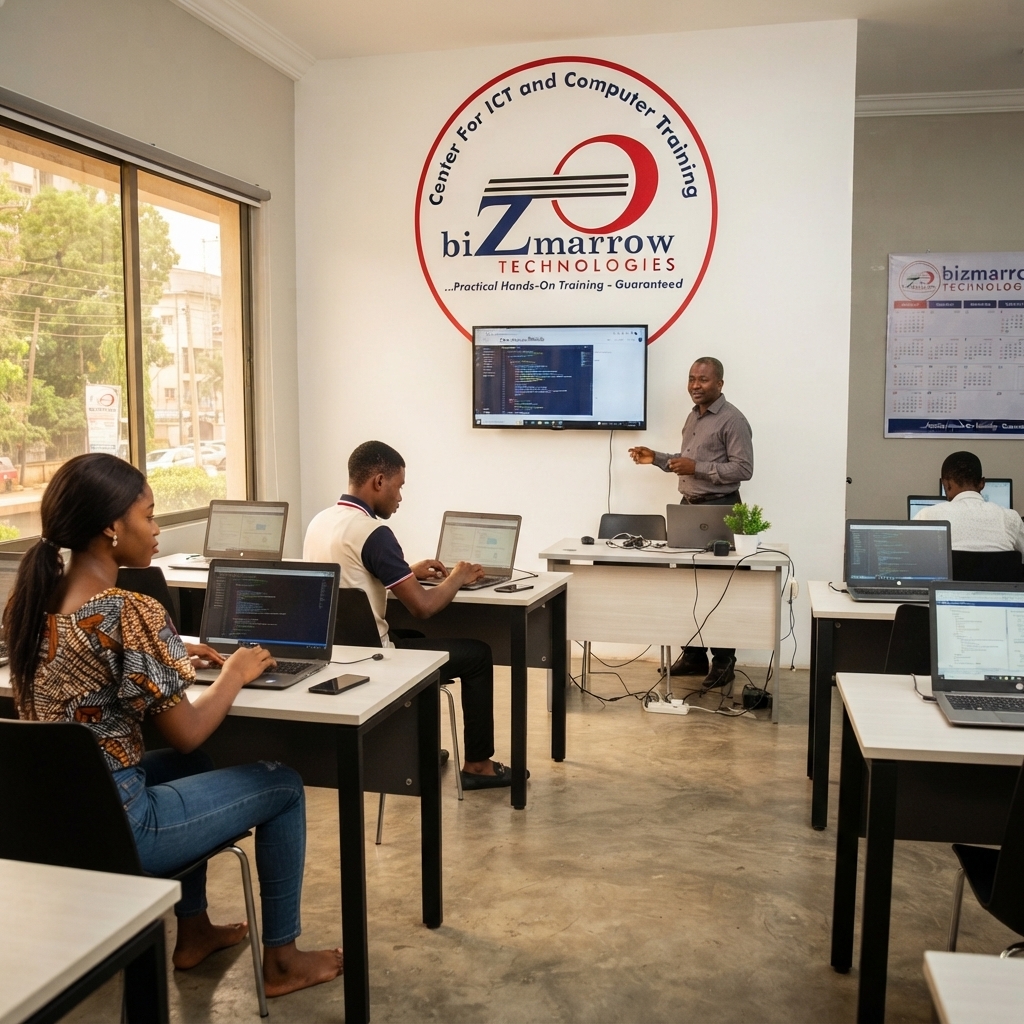
If you are searching for the best tech training institute in Abuja Nigeria, a top ICT training center in Abuja, or a computer training school in Abuja Nigeria, Bizmarrow Technologies provides practical technology and career-development training for beginners, students, and professionals.
Bizmarrow emphasises 90% practical training, helping students apply what they learn instead of relying entirely on classroom theory.
Learners receive step-by-step tutor guidance and work on real-life projects before graduation, helping them develop practical experience and build a portfolio that can demonstrate their abilities.
Training can also include career support and job-readiness preparation, helping learners prepare for employment, freelance work, entrepreneurship, and other professional opportunities.
Bizmarrow Abuja Locations
Central Business District (CBD):
Suite B106 & B108, Millennium Plaza, Opposite NNPC Towers, Herbert Macaulay Way, Central Business District, Abuja.
Gwarinpa:
Suite 10 & 15, H-MEDIX Mall, 2nd Avenue, Gwarinpa, Abuja.
If you are searching for “mobile app development training near me,” “UI/UX training near me,” “mobile tech courses near me,” or asking, “Where can I learn mobile technology in Abuja?”, Bizmarrow has training locations in both CBD and Gwarinpa.
Frequently Asked Questions About Mobile Tech Skills
What mobile tech skills are in demand in Nigeria?
Mobile app development, UI/UX design, backend and API development, mobile testing, cybersecurity, cloud technologies, product management, and mobile analytics are useful areas to explore.
Which mobile skill is best for beginners?
There is no single skill that is suitable for everyone. Beginners should consider their interests and career goals. Programming enthusiasts may explore app development, while creative learners may start with UI/UX design.
How much does it cost to learn mobile technology in Nigeria?
Training costs can range from approximately ₦50,000 to ₦350,000+, depending on the skill, provider, course duration, practical content, mentorship, and learning format.
Can I learn mobile app development without experience?
Yes. Beginners can start with basic computer and programming concepts before progressing to mobile application development.
Can mobile tech skills help me get a job?
Yes. Mobile technology skills can support opportunities in employment, internships, freelance work, contract projects, startups, agencies, and entrepreneurship. Your practical ability, portfolio, communication, and experience are important considerations.
Do I need a laptop to learn mobile app development?
A suitable computer is strongly recommended for most professional mobile development training because development environments, emulators, code editors, and testing tools are generally easier to use on a computer.
How long does it take to learn mobile technology?
The timeframe depends on the skill and the learner’s previous experience. Beginners can develop foundational skills within a few months through structured learning and consistent practice, while professional proficiency requires continued project work.
Where can I learn mobile tech skills in Abuja?
Bizmarrow Technologies provides practical technology training in Central Business District and Gwarinpa, Abuja, with 90% practical training, real-life projects before graduation, tutor guidance, career support, and job-readiness preparation.
Start Building Your Mobile Tech Career
Mobile technology offers several learning paths, from app development and UI/UX design to cybersecurity, cloud technologies, testing, backend development, and product management.
Instead of chasing every new technology, choose a skill aligned with your goals and develop it through consistent practice and real projects.
At Bizmarrow Technologies, learners are encouraged to Learn. Build. Grow. through 90% practical training, real-life projects before graduation, personalised mentorship, career support, and job-readiness preparation.
About The Author