









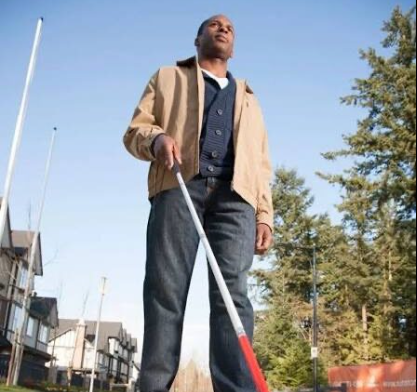
A Kenyan-built artificial intelligence tool is seeking to make everyday movement safer and more independent for people with visual impairments by helping users identify obstacles as they navigate Nairobi.
The platform, known as Sightra, combines artificial intelligence, audio guidance and GPS navigation through a web application that can be accessed using a smartphone.
The system is being developed by Kenyan founders Ruth Nzuki and Brian Gillo as an assistive navigation solution designed around the realities of African infrastructure.
As users move, the system uses AI-powered object detection to identify obstacles along their path. The information is then converted into speech and delivered to the user through an earpiece. GPS technology also helps guide users from their starting point to their intended destination.
The technology is not designed to replace a mobility cane. Instead, it is intended to provide an additional layer of information about obstacles that may be further ahead than a cane can immediately detect.
Lawyer Julius Mbura, who has a visual impairment, has been testing the system while moving between his car park and office in Nairobi.
He said the real-time audio descriptions help him identify obstacles such as parked vehicles and trees. Mbura described the technology as promising but also noted that improvements are still needed in its accuracy and the descriptions it provides.
The willingness to identify these limitations is important, as assistive technologies need to be sufficiently reliable to support users in real-world environments.
Designed Around Kenyan Infrastructure
The Nairobi environment presents particular technical challenges for assistive navigation.
Walking routes can include open drains, missing kerbs, damaged surfaces, crowded spaces, parked vehicles and sudden changes in the physical environment.
The Sightra team said its AI models have therefore been trained and tested around Kenyan infrastructure rather than relying entirely on environments with smoother roads and more predictable pedestrian routes.
This local focus could prove particularly important.
Technologies developed in other parts of the world can struggle when introduced into environments that differ significantly from those used during their development and training.
By designing AI around African conditions, local developers have an opportunity to build solutions that are better suited to the challenges experienced by African users.
Testing, Accessibility and Affordability
Kenya’s 2022 Demographic and Health Survey reported that about 2 per cent of people aged five and above had some difficulty seeing.
The developers said Sightra is already being tested through partnerships with schools serving visually impaired students, as well as with individual users.
The service operates on a subscription model costing $100 annually, although the first six months are currently offered free.
Affordability will remain an important consideration. An innovation can only help expand independence if the people who need it can access the technology and if the system performs reliably in everyday environments.
The Wider Accessibility Challenge
The development of technologies such as Sightra also raises a broader policy issue.
While technology can help people navigate inaccessible streets and buildings, it does not remove the responsibility of governments and developers to make physical infrastructure more accessible in the first place.
Kenya’s National Council for Persons with Disabilities has acknowledged that roads, buildings and other aspects of the physical environment continue to present challenges for people living with disabilities.
Sightra represents the type of innovation that can emerge when local developers begin with local problems.
African technology does not always have to replicate products developed elsewhere. In some cases, its greatest advantage comes from understanding the streets, pavements, drains, buildings and communities that global developers may never have designed for.
Sightra is still evolving, and its creators acknowledge that more work is required. However, this reflects how practical innovation develops: by starting with a real problem, building a solution informed by local realities and using technology to expand independence rather than leave people behind.
About The Author