









Is There Demand for Web Designers in Nigeria?

Is There Demand for Web Designers in Nigeria?

Yes, there is demand for web designers in Nigeria. Businesses need websites to establish an online presence, attract customers, showcase their services and support digital sales. However, the strongest opportunities are increasingly for designers who can build mobile-friendly, functional and search-friendly websites, not just attractive pages. For beginners asking, “Is web design still in demand…


Read More
How Long Does It Take to Learn Web Design?

How Long Does It Take to Learn Web Design?

You can learn the basics of web design in about 1–3 months, but becoming confident enough to build professional websites usually takes 3–6 months of consistent practice. The exact time depends on your learning goals, previous computer knowledge, study schedule and the type of websites you want to create. For beginners in Nigeria asking, “How…

Read More
How Much Can a Web Designer Earn in Nigeria?

How Much Can a Web Designer Earn in Nigeria?

A web designer in Nigeria can earn approximately ₦80,000–₦500,000 per month, depending on experience, skills, client type and whether they work for an employer or as a freelancer. These are indicative ranges, not guaranteed salaries. Freelancers may also earn per project rather than receive a fixed monthly income. For beginners asking, “How much can a…

Read More
How Much Does It Cost to Learn Web Design in Nigeria?

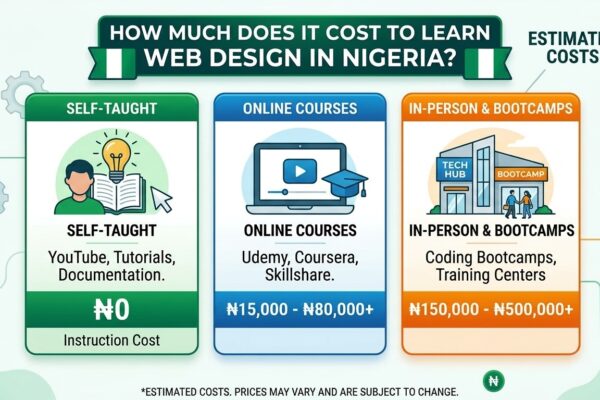
How Much Does It Cost to Learn Web Design in Nigeria?

Learning web design in Nigeria can cost anywhere from ₦50,000 to ₦300,000 or more, depending on the course, training provider, duration and skills you want to acquire. Short beginner courses are usually more affordable, while comprehensive programmes that include practical projects, mentorship and advanced development skills cost more. For anyone asking, “How much does it…

Read More
Menxtt Tech NG Strengthens Cybersecurity and Digital Document Protection for Nigerian Businesses

Menxtt Tech NG Strengthens Cybersecurity and Digital Document Protection for Nigerian Businesses

As businesses across Nigeria continue to adopt digital technology, the need to protect corporate information, devices and online operations from cyber threats has become increasingly important. For Menxtt Tech NG, a technology solutions company based in Ikeja, Lagos, cybersecurity should no longer be regarded as a concern limited to large corporations. Whether an organisation is…

Read More
The Technology Company Shaping the Future of Nigeria’s Retail Investment Industry

The Technology Company Shaping the Future of Nigeria’s Retail Investment Industry

Nigeria’s retail investment market is undergoing significant change, and the key question may no longer be whether Nigerians want to invest. Instead, the focus is increasingly on whether the capital market is developing products, systems and experiences that understand the people it seeks to attract. This is the focus of a recent report by Check,…

Read More
Microsoft South Africa CEO Urges Trusted Digital Infrastructure to Accelerate Africa’s Fintech Growth

Microsoft South Africa CEO Urges Trusted Digital Infrastructure to Accelerate Africa’s Fintech Growth

Microsoft South Africa CEO, Vukani Mngxati, has called for increased investment in trusted digital infrastructure as Africa’s financial technology sector continues to expand, identifying cloud computing, data and artificial intelligence as foundational elements of modern economies. Mngxati made the remarks during a panel discussion at the MTN Fintech Summit 2026, where industry leaders explored how…

Read More
# South Africa’s Betting Boom Creates New Demands for Technology Almost **85% of experienced Brazilian punters** bet almost exclusively through frequent, small-stake, live in-play wagers. South African bettors, however, follow a different pattern: they place fewer bets, at higher stakes, and with more time between wagers. This difference in behaviour forms the basis of joint research by **SOFTSWISS's Alexander Kamenetskyi and OddsMarket's Sergii Mykhailenko**. The research highlights the importance of understanding player behaviour when developing appropriate product settings, risk controls and fraud-prevention technology that can effectively respond to the realities of each market. ### What South Africa’s Betting Pattern Requires from Technology Differences in player behaviour affect almost every layer of an operator's operations, including how deposit and withdrawal limits are set, when identity checks are triggered and where automated systems distinguish between a legitimate large stake and a potentially suspicious transaction. Applying settings designed for a high-frequency market such as Brazil to South Africa could result in systems designed to detect large volumes of small transactions looking for the wrong indicators. This can have implications for both commercial performance and the wider industry's effectiveness. The clearest example can be seen in **fraud prevention and Know Your Customer (KYC)** processes. South African operators have developed fraud-prevention and KYC systems around identity checks at registration, as well as deposit and withdrawal monitoring calibrated more towards transaction size than frequency. This approach reflects a market where bettors tend to place larger, more considered wagers less frequently. Brazil's rapidly growing market, by contrast, is developing infrastructure around a different baseline: high-frequency, high-volume live wagering. As a result, the type of activity that may represent an anomaly in Brazil can look very different from what would be considered unusual in South Africa. The same principle applies to product design and operational processes. A deposit limit or verification trigger designed around the betting patterns of one market may not necessarily work effectively in another. ### Meeting the Regulatory Standard While Adapting to South Africa South Africa's **National Gambling Board** launched a Verified Gambling Operators portal in April, bringing licensing data from nine provincial authorities together in one place. The platform allows bettors to verify whether an operator holds a valid licence before making a deposit — an important development given that operators trading without licences have contributed significantly to the industry's credibility challenges in South Africa. While a licence confirms that an operator meets the required regulatory standard, it does not determine how effectively its systems are adapted to South African bettors. Two operators may hold identical licences but operate very different systems behind the scenes. One may rely on slower, manual identity checks, while another may use automated monitoring designed around the way South African bettors actually behave. That difference can determine whether local betting patterns are accurately identified and managed. South Africa's gambling turnover reached **R1.5 trillion in the 2024/25 financial year**, representing a **31.3% increase** from the previous year. However, growth on this scale has not fundamentally altered the underlying betting pattern. South African bettors continue to place fewer, larger wagers rather than moving towards the frequent, small-stake betting that is driving volume in faster-growing emerging markets. Instead, the growth increases the cost of getting market-specific settings wrong. An operator applying Brazil's approach in South Africa — or South Africa's approach in Brazil — risks running product, risk-management and compliance systems designed for a type of bettor that does not generally reflect the behaviour of that particular market. Effective localisation therefore requires more than simply entering a new market. It means ensuring that **product, risk and compliance systems are built around the behaviour of local bettors**. Achieving this requires technology that can be reconfigured from one market to another, as well as providers with the experience and capability to implement those adaptations effectively.

What South Africa’s betting boom demands from technology

Almost 85% of experienced Brazilian punters bet almost exclusively through frequent, small-stake, live in-play wagers. South African bettors, however, follow a different pattern: they place fewer bets, at higher stakes, and with more time between wagers. This difference in behaviour forms the basis of joint research by SOFTSWISS’s Alexander Kamenetskyi and OddsMarket’s Sergii Mykhailenko. The…

Read More