









Nigeria’s retail investment market is undergoing significant change, and the key question may no longer be whether Nigerians want to invest. Instead, the focus is increasingly on whether the capital market is developing products, systems and experiences that understand the people it seeks to attract.
This is the focus of a recent report by Check, a product and technology company seeking to advance the industry through original research and human-centred design. Its approach is notable because it begins where many financial institutions traditionally end — with the investor.
The company’s newly released 2026 Retail Investment Innovation Report, titled “The Cost of an Unseen Investor,” offers a significant rethink of the conventional understanding of retail investors in emerging markets. Rather than simply cataloguing consumer preferences, the research challenges some of the assumptions on which the retail investment industry has traditionally been built.
Its central message is both uncomfortable and important: the industry may not have an interest problem, but an understanding problem.
For an industry measured by transaction volumes, assets under management, account openings and digital adoption, Check’s research examines what happens when the person behind the transaction becomes invisible.
The findings provide compelling evidence. About 81 per cent of research participants said they had considered investing for an average of seven to 10 years before taking meaningful action. This suggests that the gap between wanting to invest and actually doing so may be measured in years rather than days or months.
The barriers are familiar, ranging from limited capital and inadequate understanding to experiences with scams and competing financial obligations. However, their combined effect is significant.
For the industry, the lesson is straightforward: introducing another investment product or launching another marketing campaign may not be enough to turn interest into participation.
What is needed is a deeper understanding of why people hesitate. This is where Check’s proposition becomes particularly relevant. Its research seeks to move the industry away from designing primarily around transactions and returns towards designing around human behaviour.
Trust at the Centre of Investment Decisions
One of the report’s most revealing findings relates to trust. Seventy-seven per cent of participants identified a known person with personal money at stake as their primary trust signal, ranking it above marketing, ratings and even regulation.
The finding should give product designers reason to pause. Technology may make investing faster, but it does not automatically make it more trusted. A sophisticated application cannot replace credibility in the eyes of a consumer who has experienced scams or does not fully understand the investment product being offered.
For the industry, this means trust must be built into the investment experience. This could involve clearer communication, stronger community relationships, greater transparency and products that make investors feel informed rather than overwhelmed.
Another finding challenges the assumption that people invest simply because they want higher returns. Fifty-six per cent of respondents said building financial discipline was a primary reason for investing, while 81 per cent reported a recurring inability to save consistently before investing.
This offers another way of looking at investment technology. The most useful platform may not necessarily be the one offering the greatest number of products, but the one that helps users develop the discipline and confidence to build wealth consistently.
The research also shows that financial decisions are closely connected to everyday life. Family obligations, religious giving, financial responsibilities and experiences with scams all influence investment behaviour.
The Rise of the “Saver Identity”
The report’s identification of a “saver identity” is equally instructive.
Some Nigerians already use investment products, earn returns, reinvest and maintain diversified portfolios but do not consider themselves investors.
This points to a disconnect between how the industry measures participation and how consumers understand their own financial lives.
It also serves as a reminder that the retail investor is not necessarily a clearly defined category waiting to be acquired. For many people, investing is part of a broader financial journey that begins with saving, financial security and gradually building confidence.
Companies that understand this journey may therefore be better positioned to establish lasting relationships with customers.
AI and the Future of Investment Technology
Check’s research also offers a nuanced perspective on artificial intelligence.
Among participants who discussed AI, 80 per cent expressed interest in automated analysis, recommendations and updates. However, some respondents still wanted to retain control over investment decisions and custody of their money.
This points to an important principle for the next generation of financial technology: automation should empower investors rather than make them feel displaced.
The opportunity, therefore, is not simply to automate everything. Instead, technology can be used to explain, guide, recommend and simplify investment decisions while maintaining transparency and human control.
Building Beyond the App
In addressing what lies beneath the app, Check’s thinking extends beyond the interface customers see.
Its Future of Retail Investing proposition argues that the industry must improve four interconnected dimensions: functional experience, user experience, process engineering and social experience.
This means investment products must work efficiently, be intuitive to use, rely on automated and dependable processes, and increasingly connect with the social and digital environments where consumers already spend their time.
This is particularly important because even the best-designed application cannot completely compensate for inefficient infrastructure beneath it.
Check recognises that fragmented systems and semi-manual processes create friction that ultimately reaches the investor. Its ambition is therefore not simply to make investment applications look better, but to help develop the technology and processes that make investing itself faster, simpler and more dependable.
Retail Investors Are Already Reshaping the Market
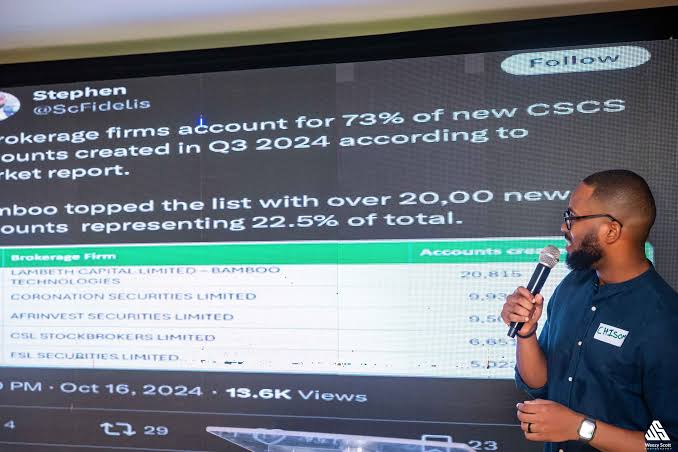
At a Retail Innovation Mixer recently held in Lagos to launch the report, Jumoke Olaniyan, Group Chief Strategy Officer of NGX Group, disclosed that retail trading reached ₦3.9 trillion in the first half of the year, compared with ₦1.47 trillion during the corresponding period last year — representing a 130 per cent increase.
He also disclosed that domestic investors now account for at least 80 per cent of trading deals.
The figures suggest that the retail investor is no longer a future prospect. Retail investors are already shaping the market, and the challenge now is to build the market around that reality.
This is where Check’s emerging role deserves attention.
The company is effectively proposing that innovation in retail investment should begin with curiosity: Who are we designing for? What do they actually experience? What prevents them from acting? What makes them trust? And what technology will genuinely help them?
Check’s 2026 report attempts to answer these questions and, importantly, translate the findings into a product and technology agenda for the capital market.
The recent mixer, which brought industry stakeholders together to examine the findings, was one expression of that agenda.
The broader significance lies in the direction Check is encouraging the industry to take: from transactions to people, from products to experiences, and from technology as an interface to technology as market infrastructure.
If Nigeria’s next phase of capital-market growth is to be powered by retail investors, then understanding and serving them better will be critical.
Check is betting that companies capable of translating that understanding into better products, better systems and better experiences will help define what comes next.
Ultimately, its most important proposition may not simply be about building technology for today’s retail investment market, but about helping the capital market design the one Nigeria will need tomorrow.
About The Author